Eight Strokes · 八つの日本の美意識
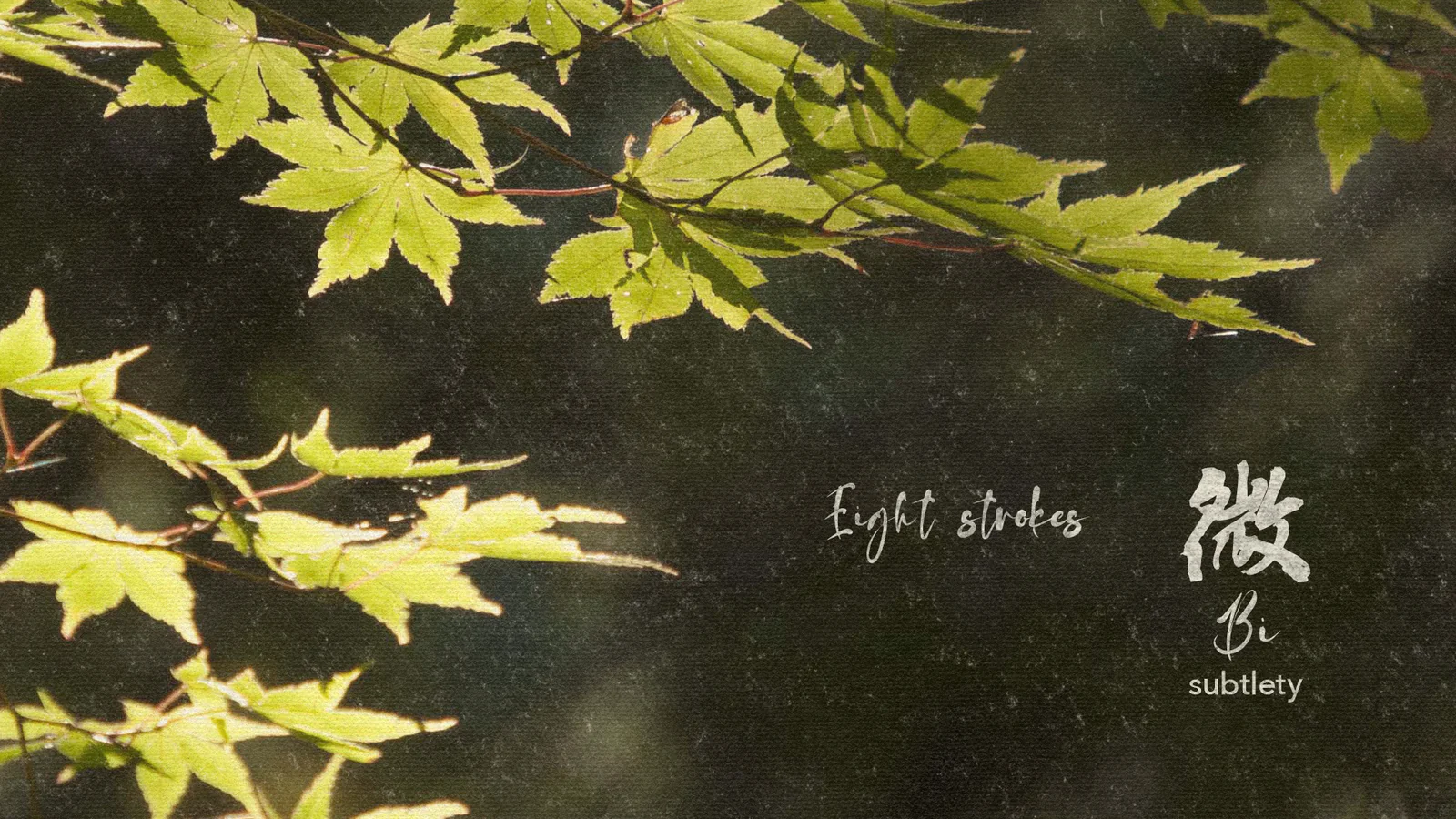
Eight Strokes — 微 Bi · subtlety
Saihoji Temple moss gardens, Kyoto (6290140464) | Photo: Bryan Ledgard, CC BY 2.0, via Wikimedia Commons
Bi (微) is the aesthetic of subtlety: a sensitivity to barely perceptible details that only show up for someone who slows down. Beauty sits in the background, in the spaces between things, in fleeting impressions and surface texture: a fading temple bell, the soft shadow of a paper screen, an intentionally imperfect brushstroke. 微 means subtle, delicate, faint. The Japanese saying 神は細部に宿る holds that the sacred lives in detail.
Bi (微) é a estética da sutileza: uma sensibilidade a detalhes quase imperceptíveis, que só aparecem para quem desacelera. A beleza fica no fundo, nos espaços entre as coisas, nas impressões fugazes e na textura da superfície: o sino de um templo que se apaga, a sombra suave de um biombo de papel, uma pincelada propositalmente imperfeita. 微 quer dizer sutil, delicado, tênue. O dito japonês 神は細部に宿る diz que o sagrado mora no detalhe.
Eight Strokes — 並 Hei · coexistence
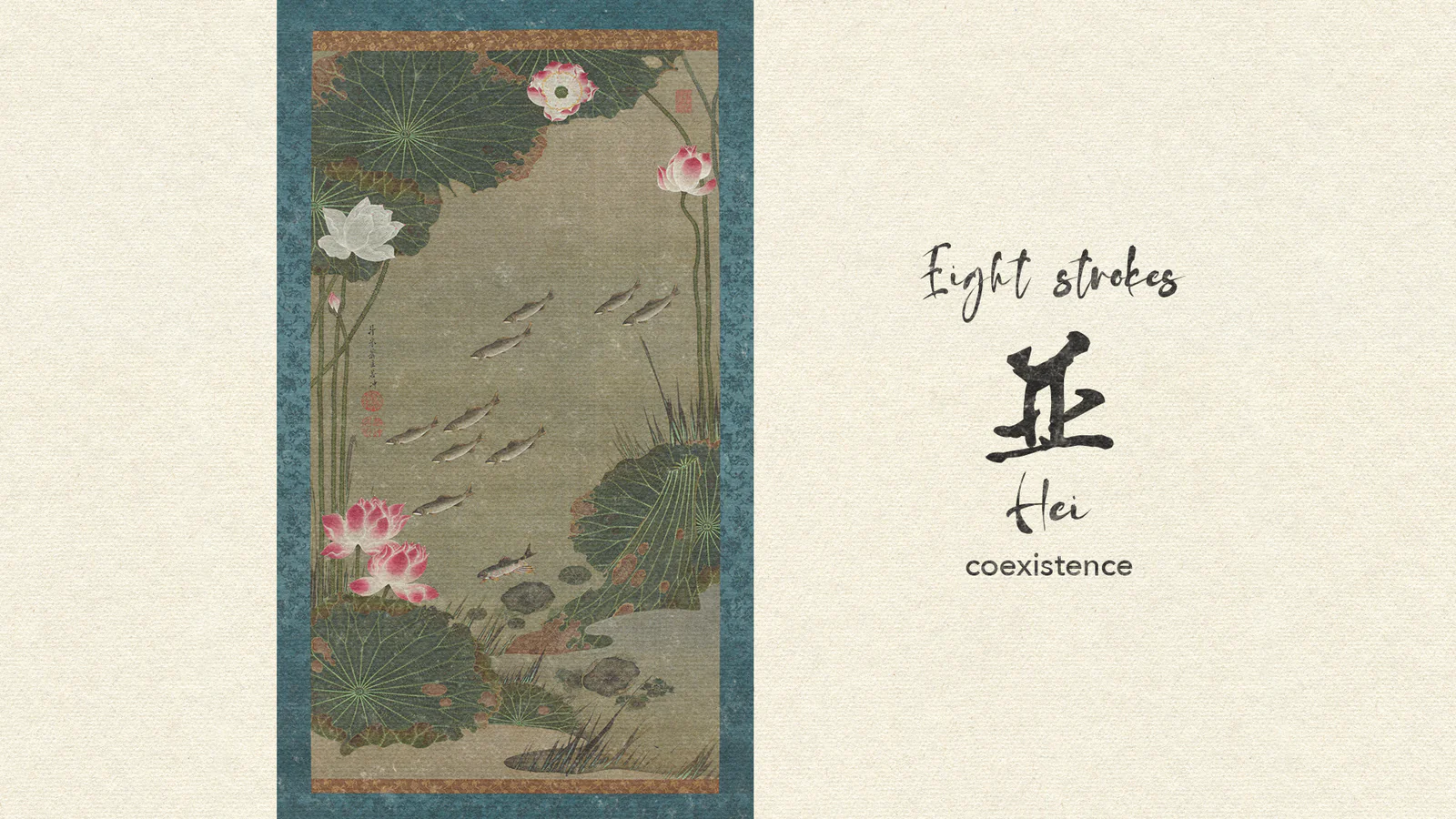
Itō Jakuchū, public domain, via Wikimedia Commons
Hei (並) is the beauty of coexistence: elements that seem contradictory live side by side without conflict, with balance and without hierarchy. Difference is something to respect, not to resolve. 並 means side by side, in parallel. It shows up in churches and Buddhist temples in the same neighborhood, in kanji, hiragana and katakana working together in one writing system, and in the household where each person picks the tableware they like.
Hei (並) é a beleza da coexistência: elementos que parecem contraditórios convivem lado a lado sem conflito, com equilíbrio e sem hierarquia. A diferença é algo a respeitar, não a resolver. 並 quer dizer lado a lado, em paralelo. Aparece em igrejas e templos budistas no mesmo bairro, nos kanji, hiragana e katakana convivendo no mesmo sistema de escrita, e na casa em que cada pessoa escolhe a louça do seu gosto.
Eight Strokes — 気 Ki · sensing the invisible
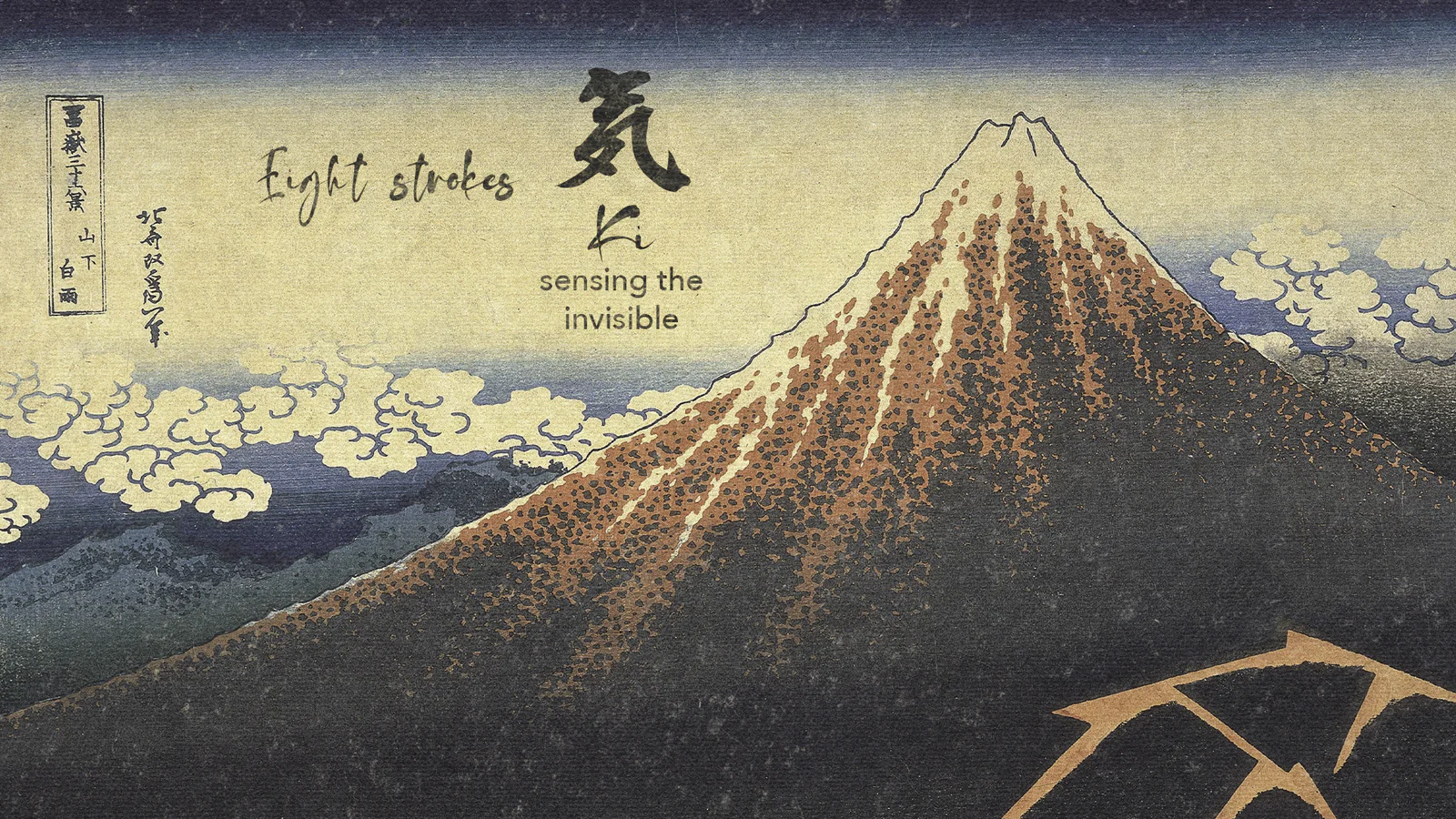
Hokusai, Rainstorm Beneath the Summit (Shimane Art Museum) | Katsushika Hokusai, public domain, via Wikimedia Commons
Ki (気) is sensing the invisible: a life force that flows through people, objects and spaces, a subtle presence felt without noise or drama. It is in the stillness of a well-composed tea room, in a Noh actor’s posture conveying intention, in a patiently shaped bonsai. In daily life it shows up as 空気を読む, reading the air: sensing the unspoken mood and responding with delicacy. In its older form the kanji is written 氣.
Ki (気) é sentir o invisível: uma força vital que corre por pessoas, objetos e espaços, uma presença sutil que se percebe sem barulho nem drama. Está na quietude de uma sala de chá bem composta, na postura de um ator de nô que mostra a intenção, num bonsai moldado com paciência. No cotidiano, aparece em 空気を読む, ler o ar: perceber o clima não dito e responder com delicadeza. Em versão antiga, o kanji se escreve 氣.
Eight Strokes — 間 Ma · the space between things
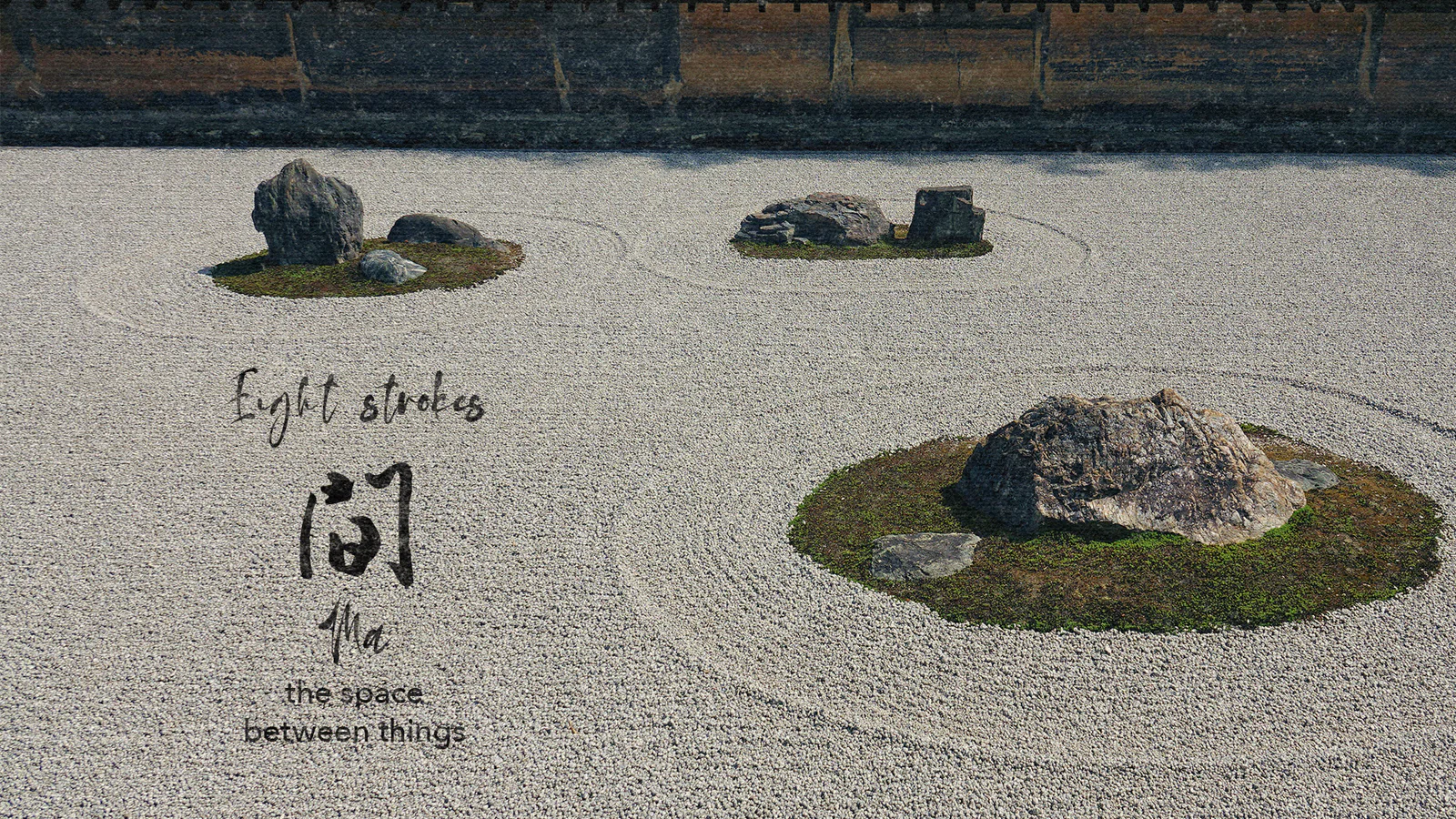
Ryoan-ji-Garden-2018 | Photo: Bjørn Christian Tørrissen, CC BY-SA 4.0, via Wikimedia Commons
Ma (間) is the space between things, the interval that gives structure, rhythm and emotional resonance, like the silence between two notes or the space between two people. Ma can only be perceived after you recognize each element, so it depends on an eye for detail, bi. Not everything has to be filled or explained. In 1978, the architect Arata Isozaki devoted the exhibition MA: Space/Time in Japan to the concept.
Ma (間) é o espaço entre as coisas, o intervalo que dá estrutura, ritmo e ressonância emocional, como o silêncio entre duas notas ou o espaço entre duas pessoas. Só se percebe o ma depois de reconhecer cada elemento, por isso ele depende do olhar atento ao detalhe, o bi. Nem tudo precisa ser preenchido ou explicado. Em 1978, o arquiteto Arata Isozaki dedicou ao conceito a exposição MA: Space/Time in Japan.
Eight Strokes — 秘 Hi · seeing without seeing
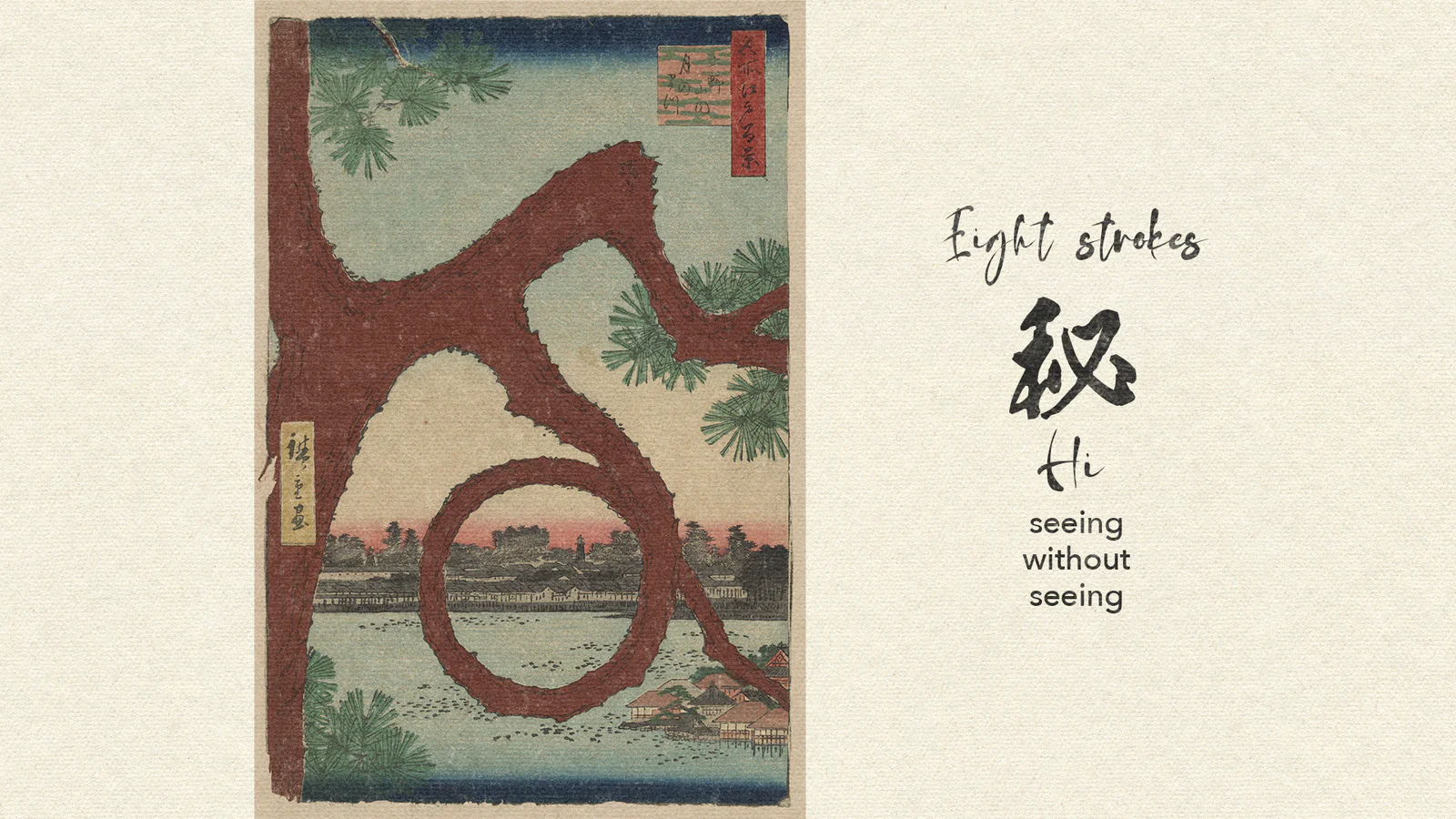
Hiroshige, Ueno sannai tsuki no matsu (LCCN2008660968) | Utagawa Hiroshige, public domain, via Wikimedia Commons (Library of Congress)
Hi (秘) is seeing without seeing: deliberately hiding part of a work to spark the imagination of whoever looks. Hiding is an invitation, not a refusal. The creator does not expect a single interpretation: they trust the viewer to complete the work with their own feelings and experiences. 秘 means secret, hidden. The classic example is Hasegawa Tōhaku’s Pine Trees screen, where much of the surface is left blank and the gaze drifts into the mist.
Hi (秘) é ver sem ver: esconder de propósito uma parte da obra para acender a imaginação de quem olha. Ocultar é um convite, não uma recusa. O criador não espera uma única interpretação: confia que o espectador complete a obra com os próprios sentimentos e experiências. 秘 quer dizer segredo, oculto. O exemplo clássico é o biombo dos Pinheiros de Hasegawa Tōhaku, em que boa parte da superfície fica em branco e o olhar se perde na névoa.
Eight Strokes — 素 So · the unadorned
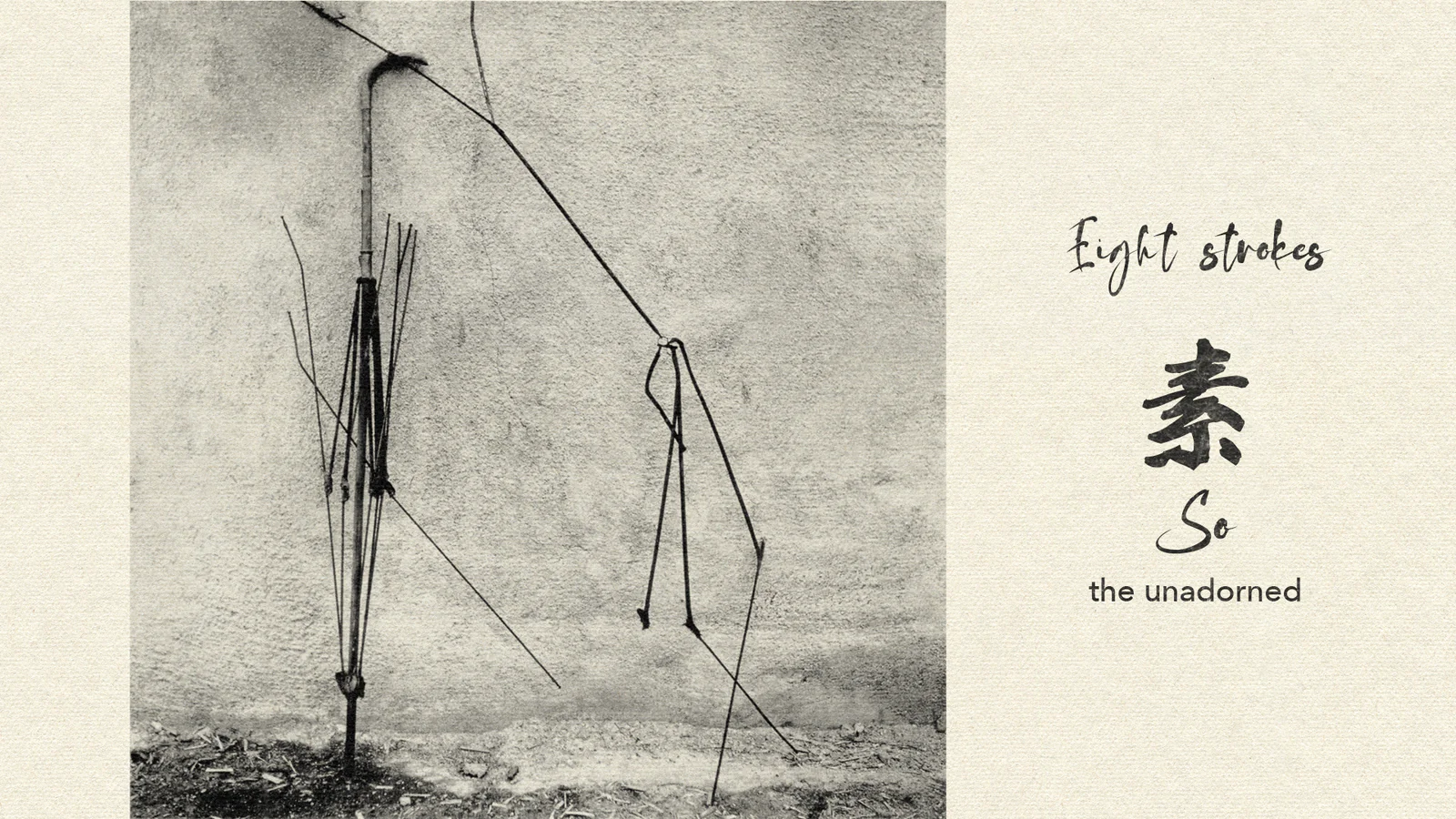
Ueda Shōji, A couple of wire (1951) | Ueda Shōji, via Wikimedia Commons
So (素) is the essence of the unadorned: leaving things in their natural state, with nothing unnecessary, and revealing a material’s inherent qualities rather than decorating it. 素 means plain, raw. Minimalism is a result of this respect for material, not the goal; simplicity comes from intention and restraint. The kimono is an example: its form barely changes, and variety comes from fabric, weave and color. So are raw linen and unfinished wood.
So (素) é a essência do que não tem adorno: deixar as coisas no estado natural, sem nada desnecessário, e revelar as qualidades do material em vez de decorá-lo. 素 quer dizer simples, cru. O minimalismo é consequência desse respeito pelo material, não o objetivo; a simplicidade nasce da intenção e da contenção. O quimono é um exemplo: a forma quase não muda, e a variedade vem do tecido, da trama e da cor. Também o linho cru e a madeira sem acabamento.
Eight Strokes — 仮 Ka · beauty in the made
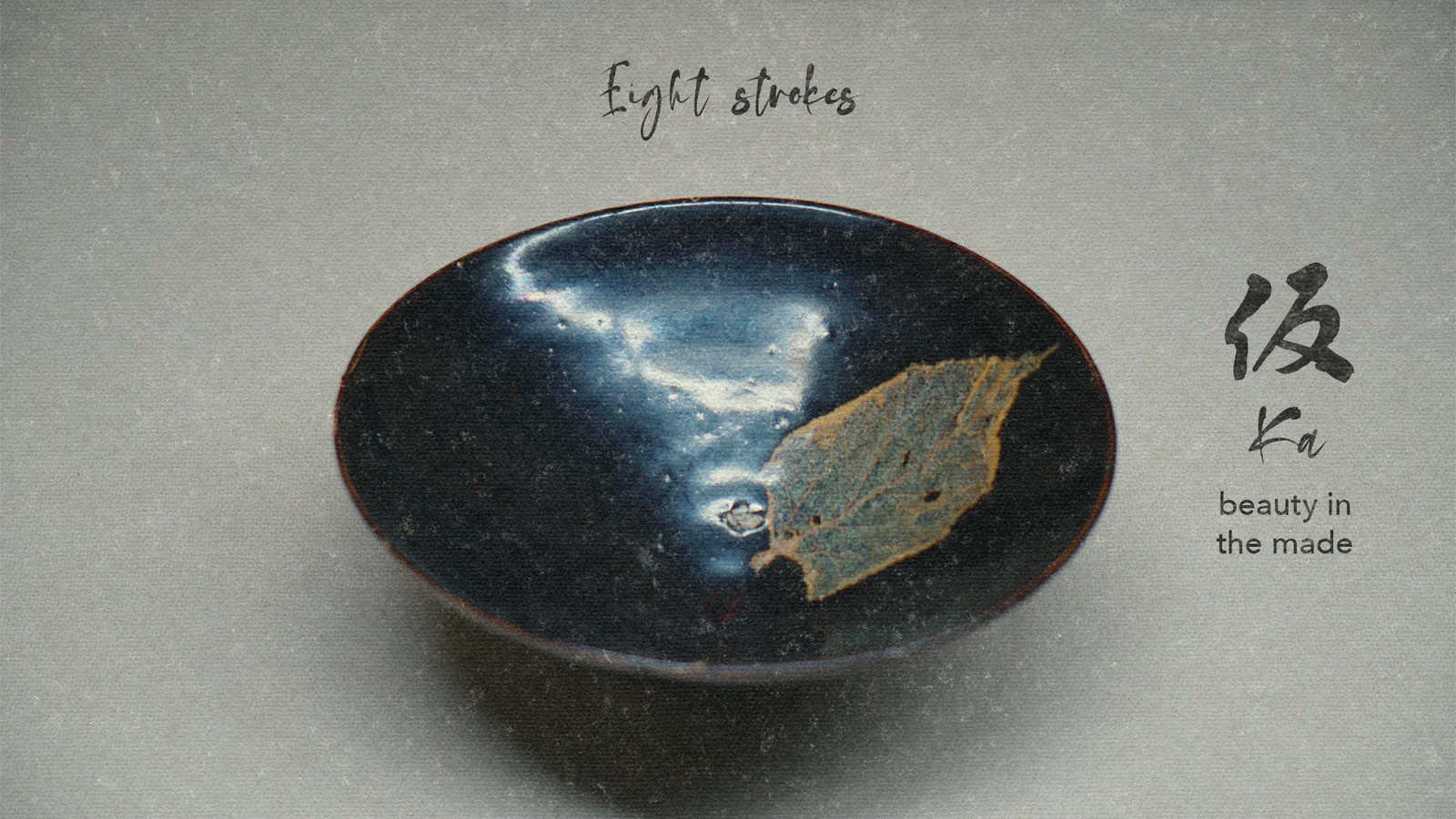
TEA BOWL, Tenmoku glaze with leaf design | Photo: 掬茶, CC BY-SA 4.0, via Wikimedia Commons
Ka (仮) is the beauty of the made: what is deliberately constructed, recreated or imitated with care. 仮 means imitation, temporary, artificial. Imitation here is not copying: it is reinterpreting tradition and giving old forms new life. Ka reflects Buddhist impermanence and encourages acceptance of change. It lives in kintsugi, which highlights the crack with gold instead of hiding it, in weathered wood, aged plaster, and stone paths shaped by time. It is a relative of wabi-sabi.
Ka (仮) é a beleza do que é feito: aquilo que é construído, recriado ou imitado com cuidado. 仮 quer dizer imitação, provisório, artificial. A imitação aqui não é cópia: é reinterpretar a tradição e dar vida nova a formas antigas. O ka reflete a impermanência budista e convida a aceitar a mudança. Está no kintsugi, que destaca a rachadura com ouro em vez de escondê-la, na madeira envelhecida, no reboco gasto, no caminho de pedras moldado pelo tempo. É parente do wabi-sabi.
Eight Strokes — 破 Ha · breaking to become
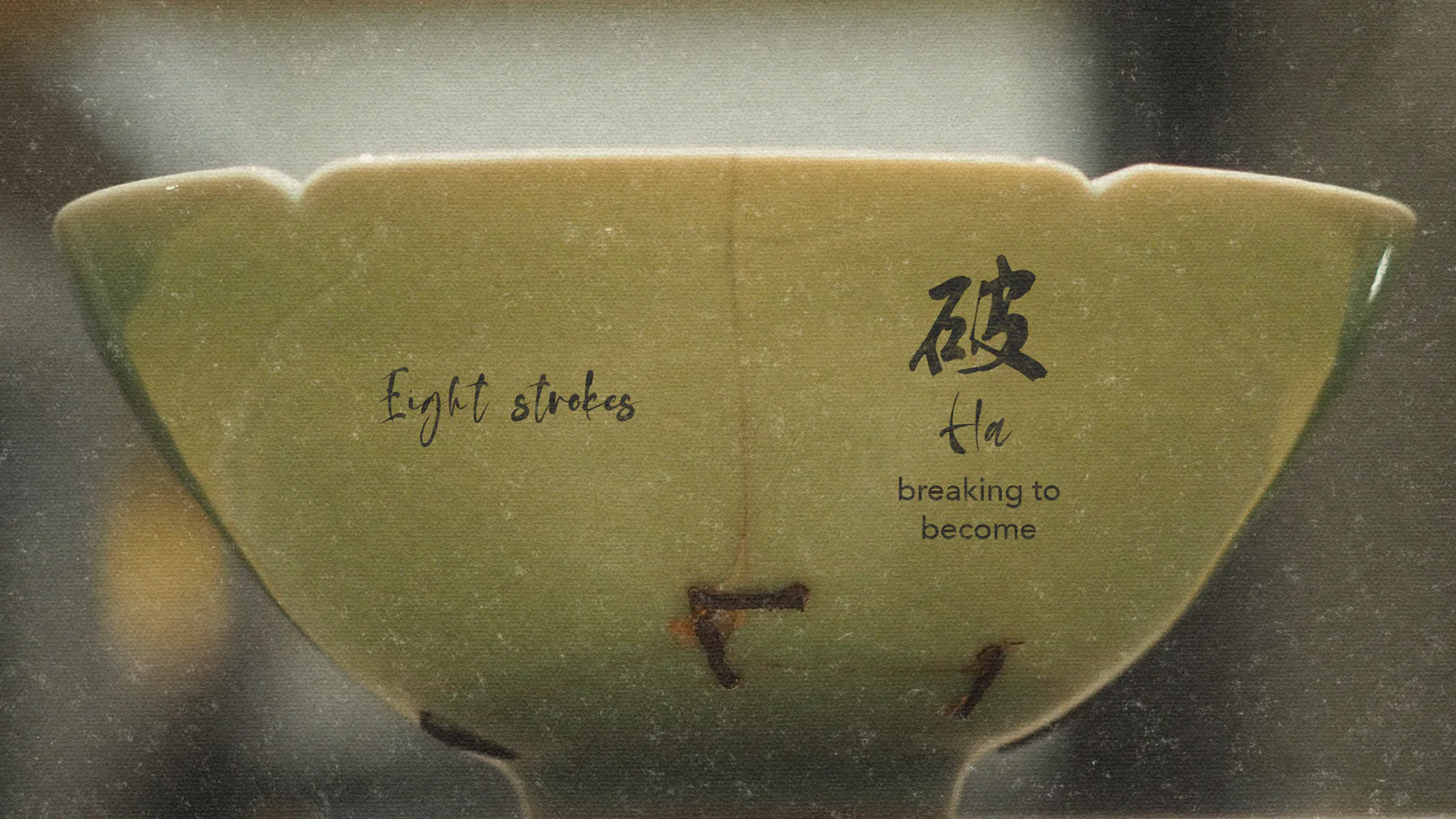
Bakohan 20190307 135852a | Photo: Ka23 13, CC BY-SA 4.0, via Wikimedia Commons
Ha (破) is breaking to become: intentionally breaking an established form to move beyond tradition, without being mere rebellion. 破 means to break, to tear apart. It is creative energy, not destruction, and it only works after the form has been understood and mastered: ha builds on tradition rather than rejecting it. Hokusai reimagining classical painting through ukiyo-e and Issey Miyake’s folded, sculptural garments are examples. It counterbalances a culture that values harmony.
Ha (破) é quebrar para vir a ser: romper de propósito uma forma estabelecida para ir além da tradição, sem ser rebeldia. 破 quer dizer quebrar, romper. É energia criativa, não destruição, e só funciona depois que a forma foi entendida e dominada: o ha se apoia na tradição, não a rejeita. Hokusai reinventando a pintura clássica no ukiyo-e e as roupas dobradas e esculturais de Issey Miyake são exemplos. Faz contrapeso a uma cultura que valoriza a harmonia.
Wabi-Sabi: Seven Principles · 侘寂と七つの原則
Wabi-Sabi: Seven Principles — 侘寂 Wabi-sabi · beauty of imperfection
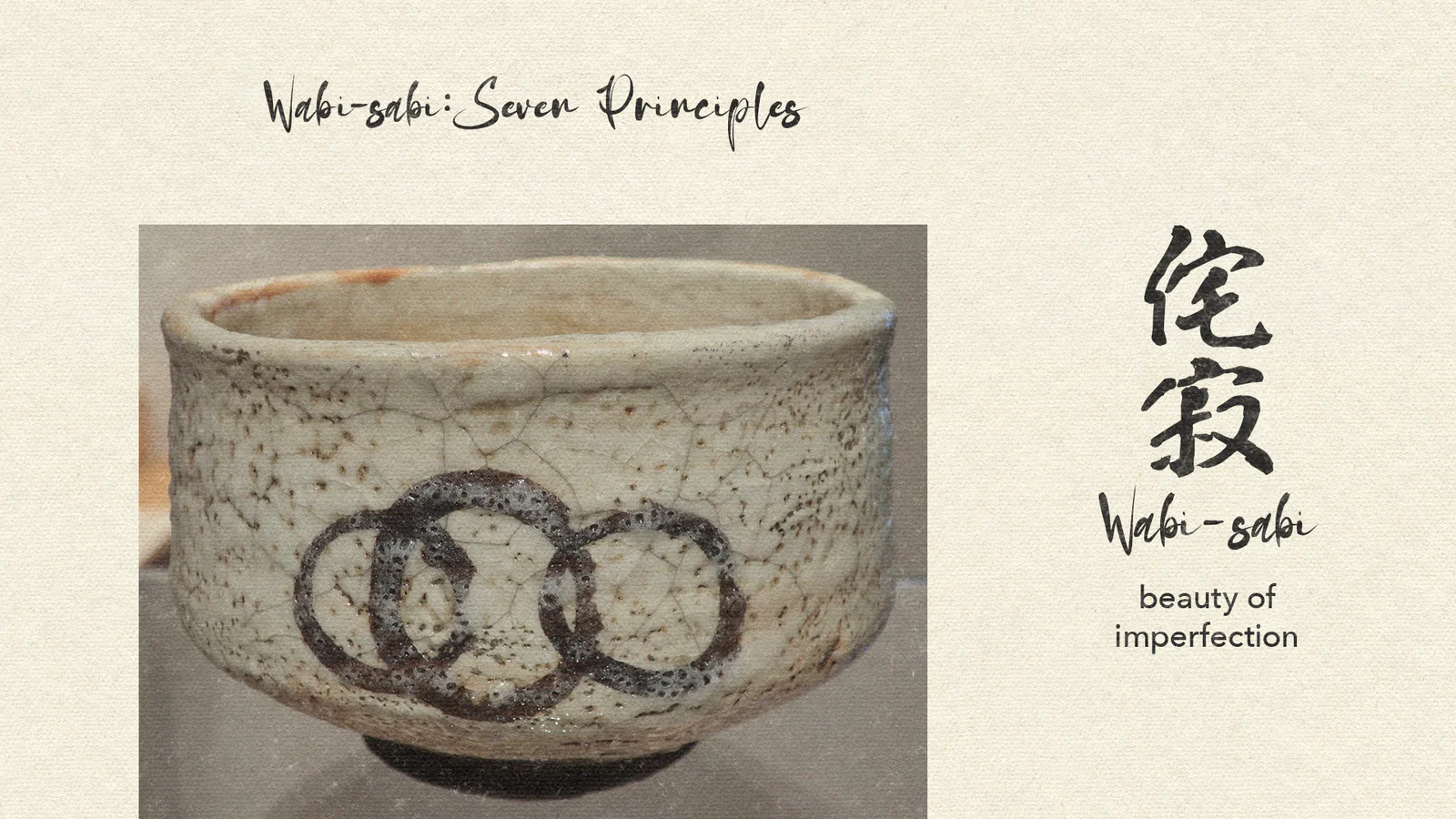
Tea bowl by Kitaōji Rosanjin, Honolulu Museum of Art 8828.1 | Photo: Hiart, public domain, via Wikimedia Commons
Wabi-sabi (侘寂) is the beauty of imperfection, modesty and impermanence. Wabi leans toward austere, rustic simplicity; sabi toward the patina of age. The word wabi developed in the tea ceremony and in Zen: at first it evoked loneliness and deprivation, and later came to mean simplicity, humility and harmony with nature. Seven principles, associated with the philosopher Hisamatsu Shin’ichi (Zen and the Fine Arts, 1971), describe how the idea shows up in Zen-influenced art.
Wabi-sabi (侘寂) é a beleza da imperfeição, da modéstia e da impermanência. O wabi aponta para a simplicidade austera e rústica; o sabi, para a pátina do tempo. A palavra wabi se desenvolveu na cerimônia do chá e no zen: no início evocava solidão e privação, e depois passou a significar simplicidade, humildade e harmonia com a natureza. Sete princípios, associados ao filósofo Hisamatsu Shin’ichi (Zen and the Fine Arts, 1971), descrevem como a ideia aparece na arte de influência zen.
Wabi-Sabi: Seven Principles — 不均斉 Fukinsei · asymmetry
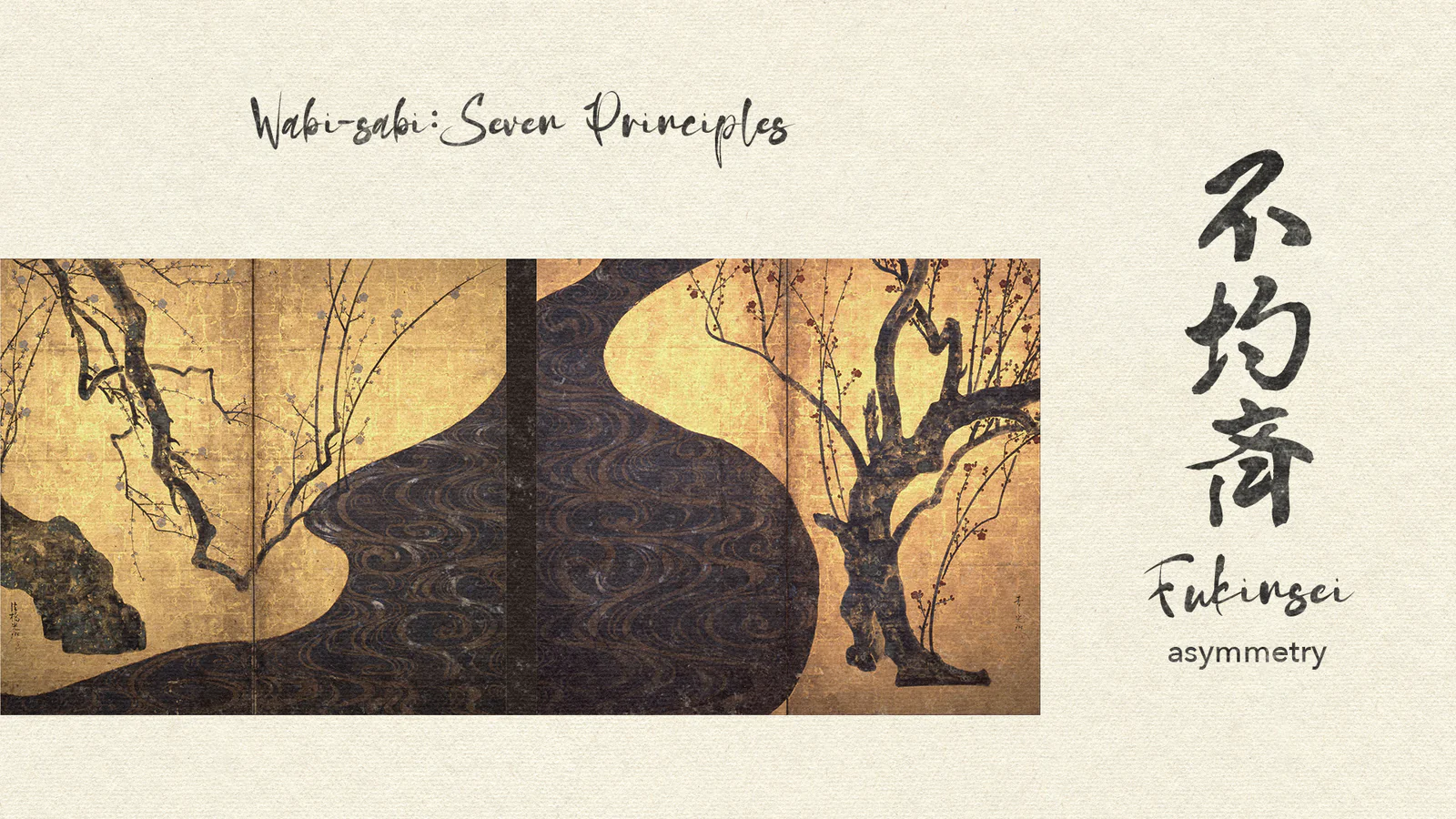
Ogata Kōrin, Red and White Plum Blossoms (National Treasure) | Ogata Kōrin, public domain, via Wikimedia Commons (Google Art Project)
Fukinsei (不均斉) is finding beauty in asymmetry and irregularity. What is perfectly regular feels finished; what is uneven feels alive and still in motion.
Fukinsei (不均斉) é encontrar beleza na assimetria e na irregularidade. O que é perfeitamente regular parece terminado; o que é desigual parece vivo e ainda em movimento.
Wabi-Sabi: Seven Principles — 簡素 Kanso · simplicity
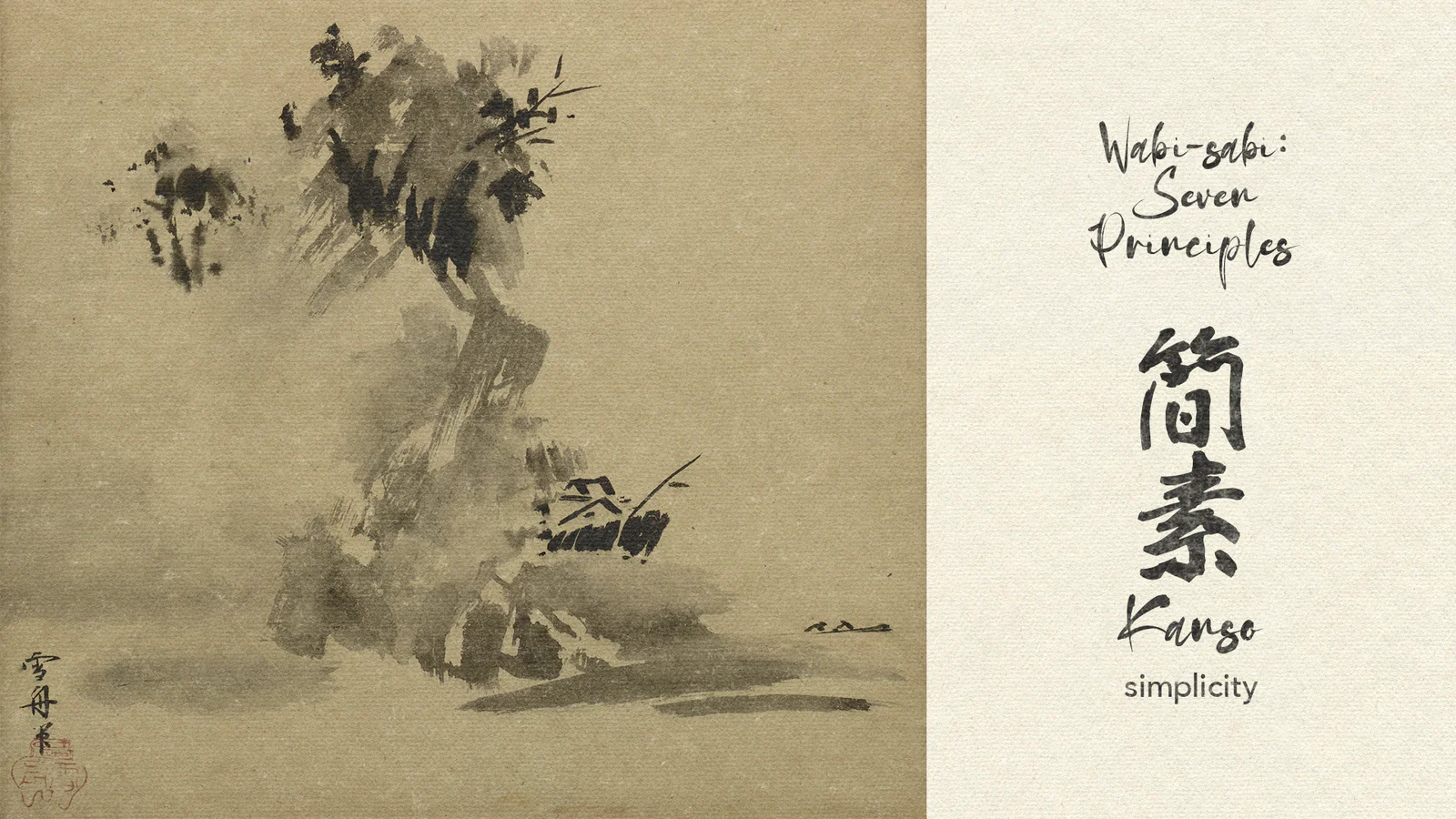
Sesshū Tōyō, Haboku-Sansui | Sesshū Tōyō, public domain, via Wikimedia Commons
Kanso (簡素) is simplicity as a path to essence, clarity through omission. It is not doing less for lack of means: it is taking away what is extra until only what matters remains.
Kanso (簡素) é a simplicidade como caminho até a essência, a clareza por omissão. Não é fazer menos por falta de recursos: é tirar o que sobra até restar o que importa.
Wabi-Sabi: Seven Principles — 考古 Kōko · age and quiet strength
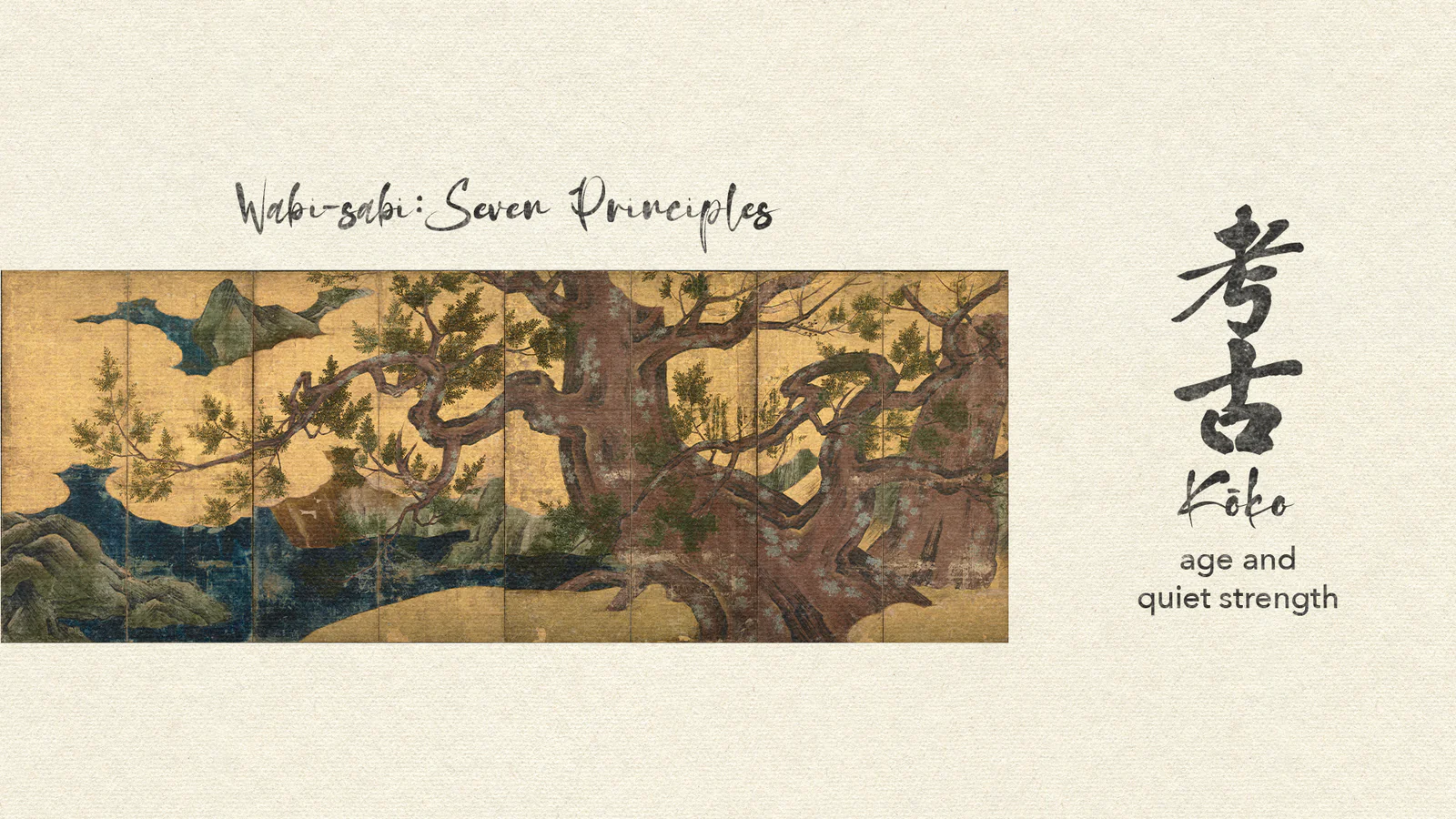
Kanō Eitoku, Cypress Trees | Kanō Eitoku, public domain, via Wikimedia Commons (Google Art Project)
Kōko (考古) is the austere quality of what has aged: the age, the patina and the quiet strength of an object that carries the marks of time. Translations vary: some say austere sublimity, others something basic and weathered by use, and some lists put shibui in place of kōko.
Kōko (考古) é a qualidade austera do que envelheceu: a idade, a pátina e a força silenciosa de um objeto que carrega as marcas do tempo. As traduções variam: algumas falam em sublimidade austera, outras em algo básico e desgastado pelo uso, e certas listas trazem o shibui no lugar do kōko.
Wabi-Sabi: Seven Principles — 自然 Shizen · letting things be
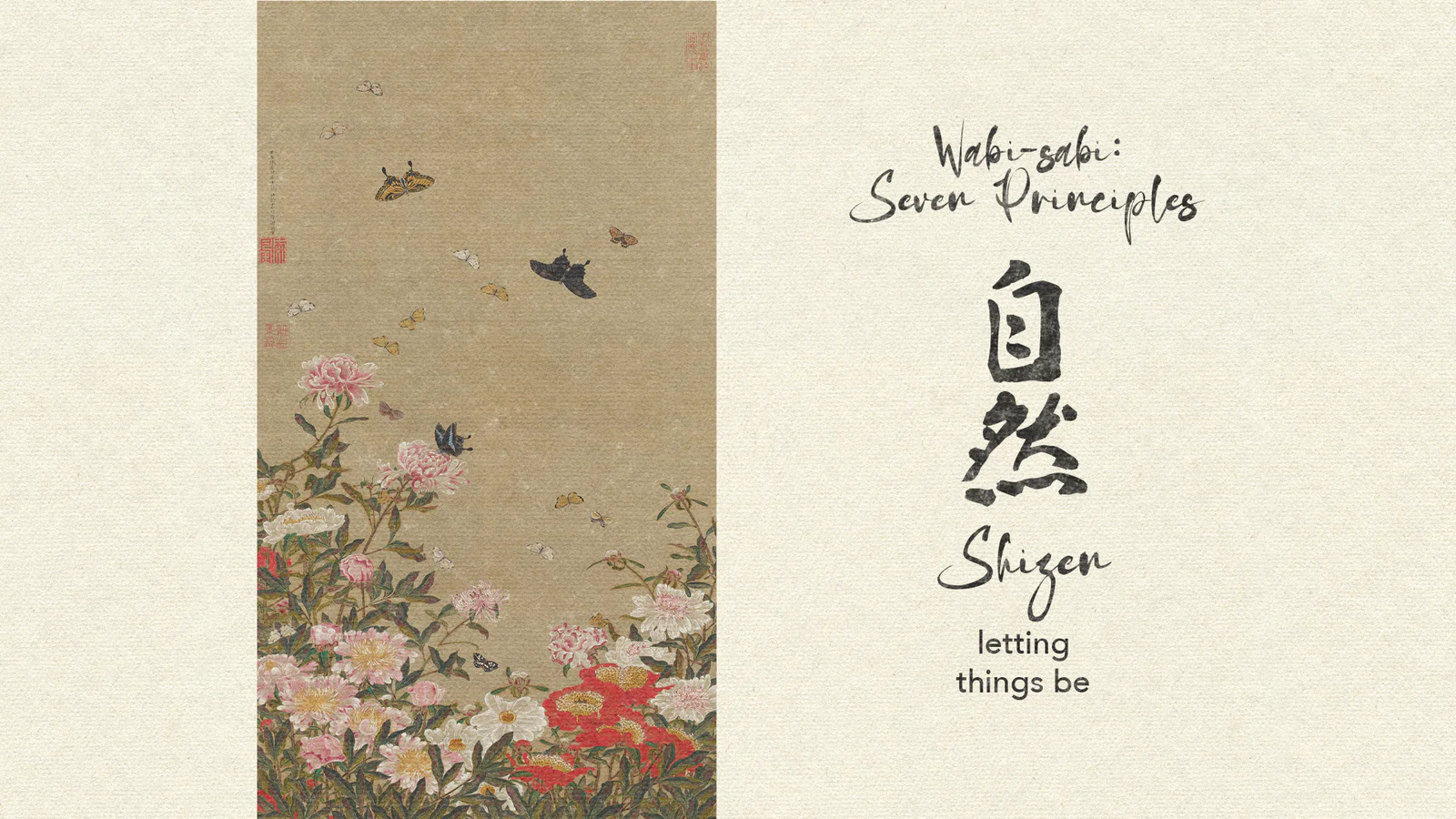
Itō Jakuchū, Herbaceous peonies and butterflies (Colorful Realm of Living Beings) | Itō Jakuchū, public domain, via Wikimedia Commons
Shizen (自然) is naturalness: letting things be as they are, without pretense and without artifice. The right form is the one that does not look forced.
Shizen (自然) é a naturalidade: deixar as coisas como são, sem pretensão e sem artifício. A forma certa é aquela que não parece forçada.
Wabi-Sabi: Seven Principles — 幽玄 Yūgen · depth beyond the seen
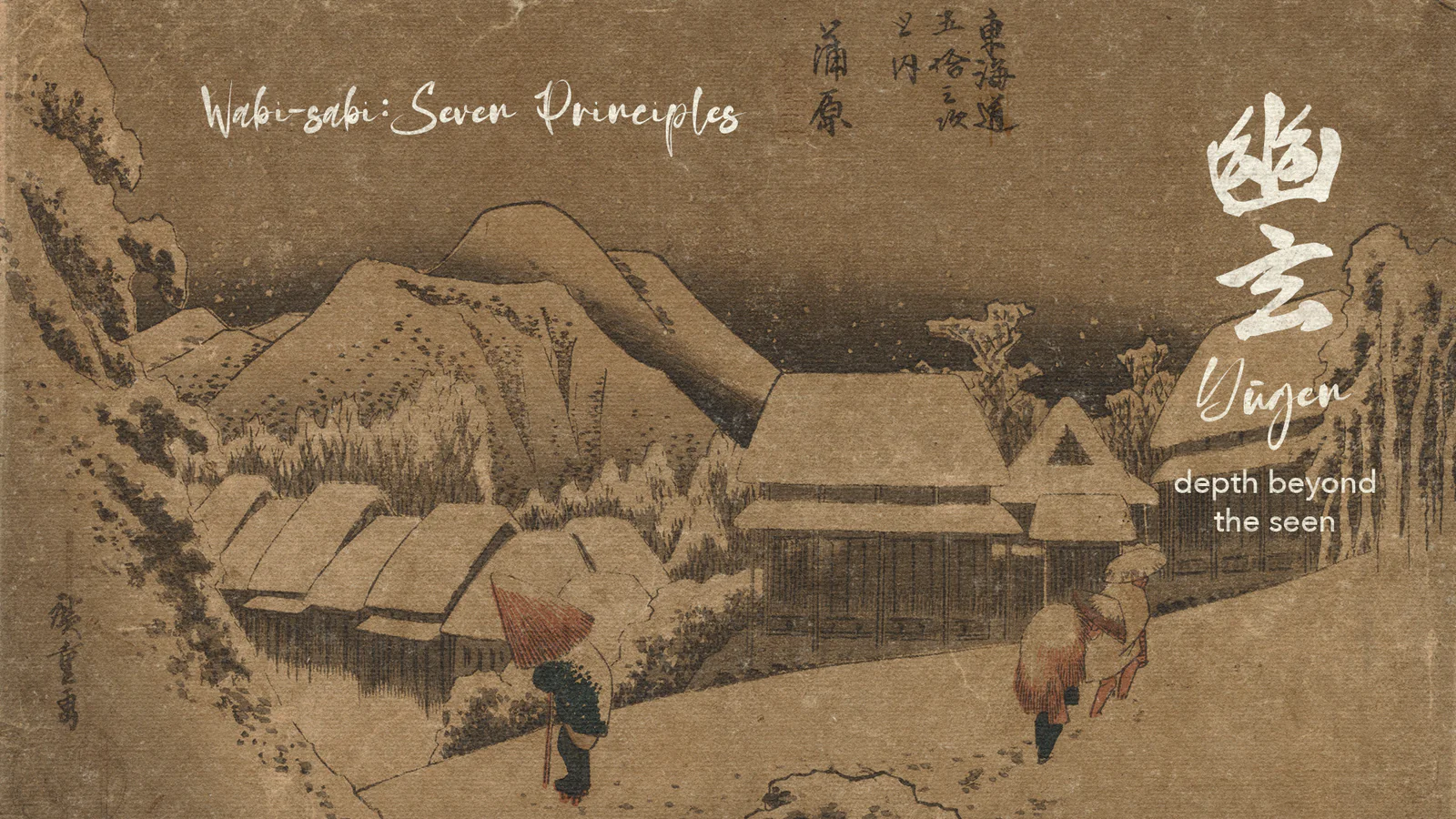
Hiroshige, Kambara: Evening Snow | Utagawa Hiroshige, CC0, via Wikimedia Commons (Cleveland Museum of Art)
Yūgen (幽玄) is subtle, profound grace, aesthetic depth beyond what is seen. A work’s presence goes beyond what is literally shown: the mystery, the suggestion, the sense that there is more behind the surface. Mist on a mountain is the classic image.
Yūgen (幽玄) é a graça profunda e sutil, a profundidade estética além do que se vê. A presença de uma obra vai além do que está literalmente mostrado: o mistério, a sugestão, a sensação de que há mais por trás da superfície. Uma névoa na montanha é a imagem clássica.
Wabi-Sabi: Seven Principles — 脱俗 Datsuzoku · stepping outside the ordinary
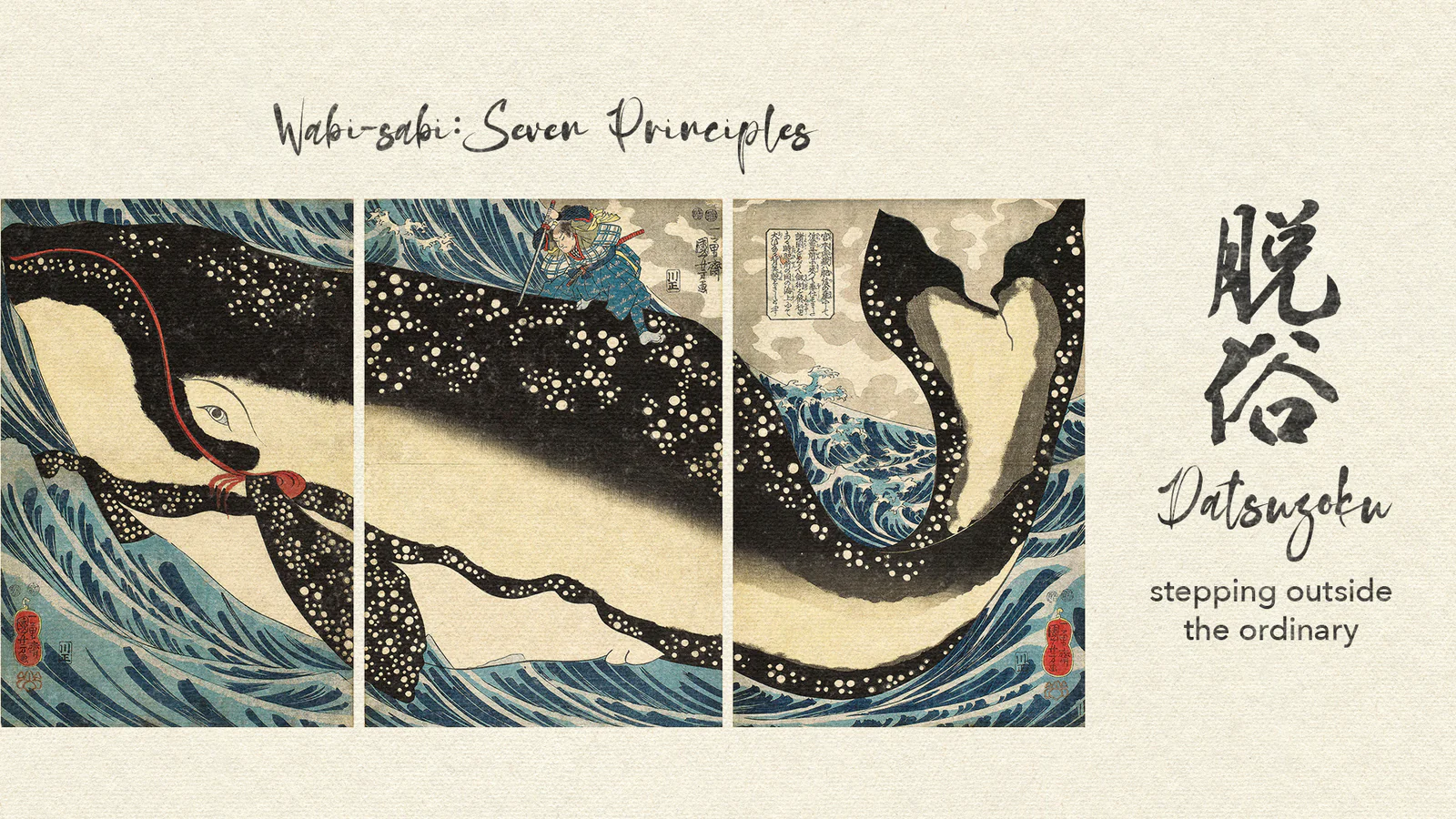
Kuniyoshi, Miyamoto Musashi Attacking the Giant Whale | Utagawa Kuniyoshi, public domain, via Wikimedia Commons
Datsuzoku (脱俗) is freedom from routine and convention, stepping outside the ordinary. It is the moment something breaks the habit and makes a person see the world as if for the first time.
Datsuzoku (脱俗) é a liberdade em relação à rotina e à convenção, sair do ordinário. É o momento em que algo rompe o hábito e faz a pessoa ver o mundo como se fosse a primeira vez.
Wabi-Sabi: Seven Principles — 静寂 Seijaku · the quiet that holds everything
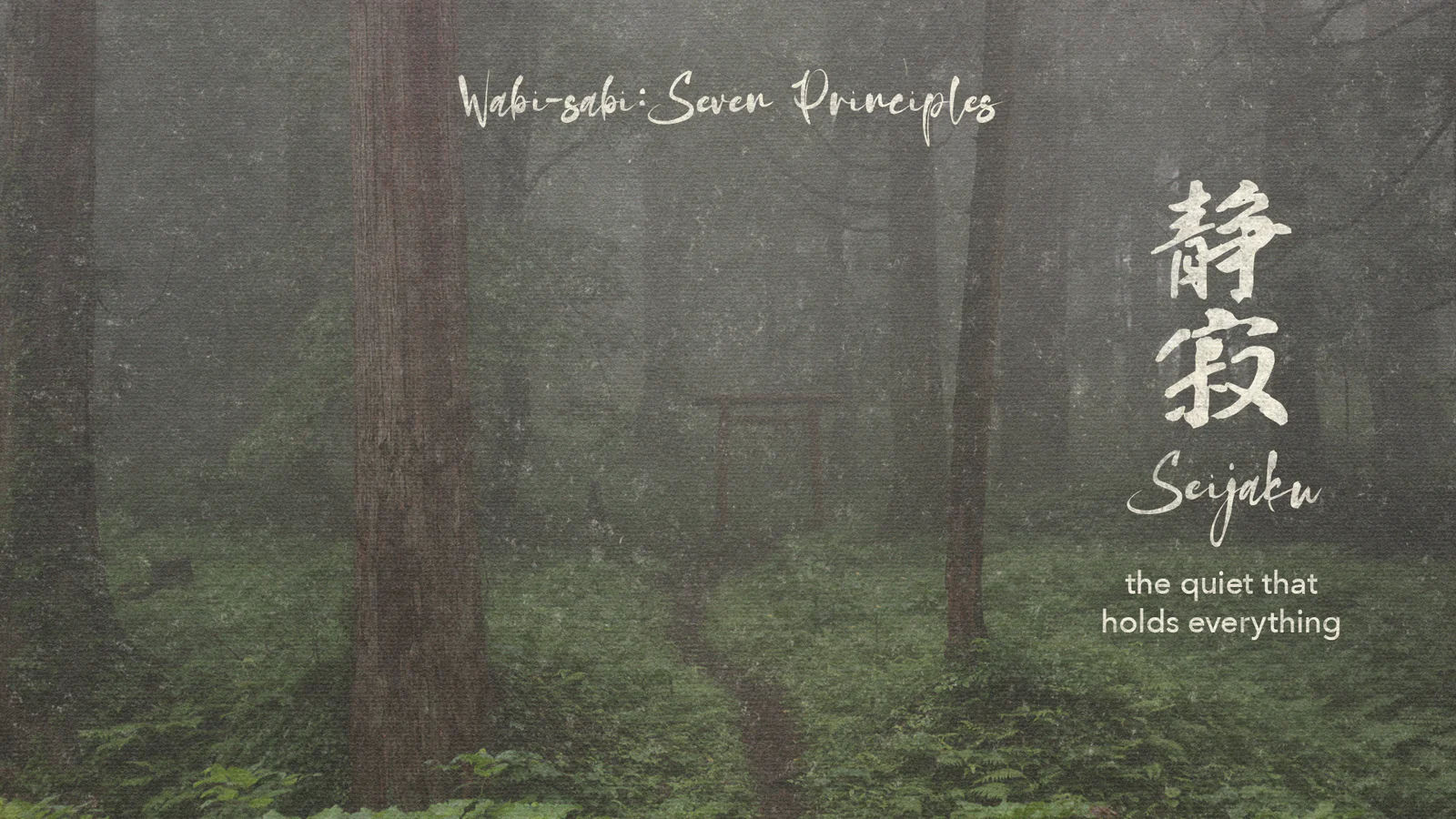
Torii in the mist v1 | Photo: Japanexperterna.se, CC BY-SA 3.0, via Wikimedia Commons
Seijaku (静寂) is tranquility, the quiet that holds everything: the active calm that exists in the middle of movement. It is not empty silence, it is the ground on which everything else happens.
Seijaku (静寂) é a tranquilidade, a quietude que sustenta tudo: a calma ativa que existe no meio do movimento. Não é silêncio vazio, é o chão sobre o qual o resto acontece.
Space, emptiness and subtraction · 余白と引き算の美
Space, emptiness and subtraction — 空 Kū · emptiness as possibility
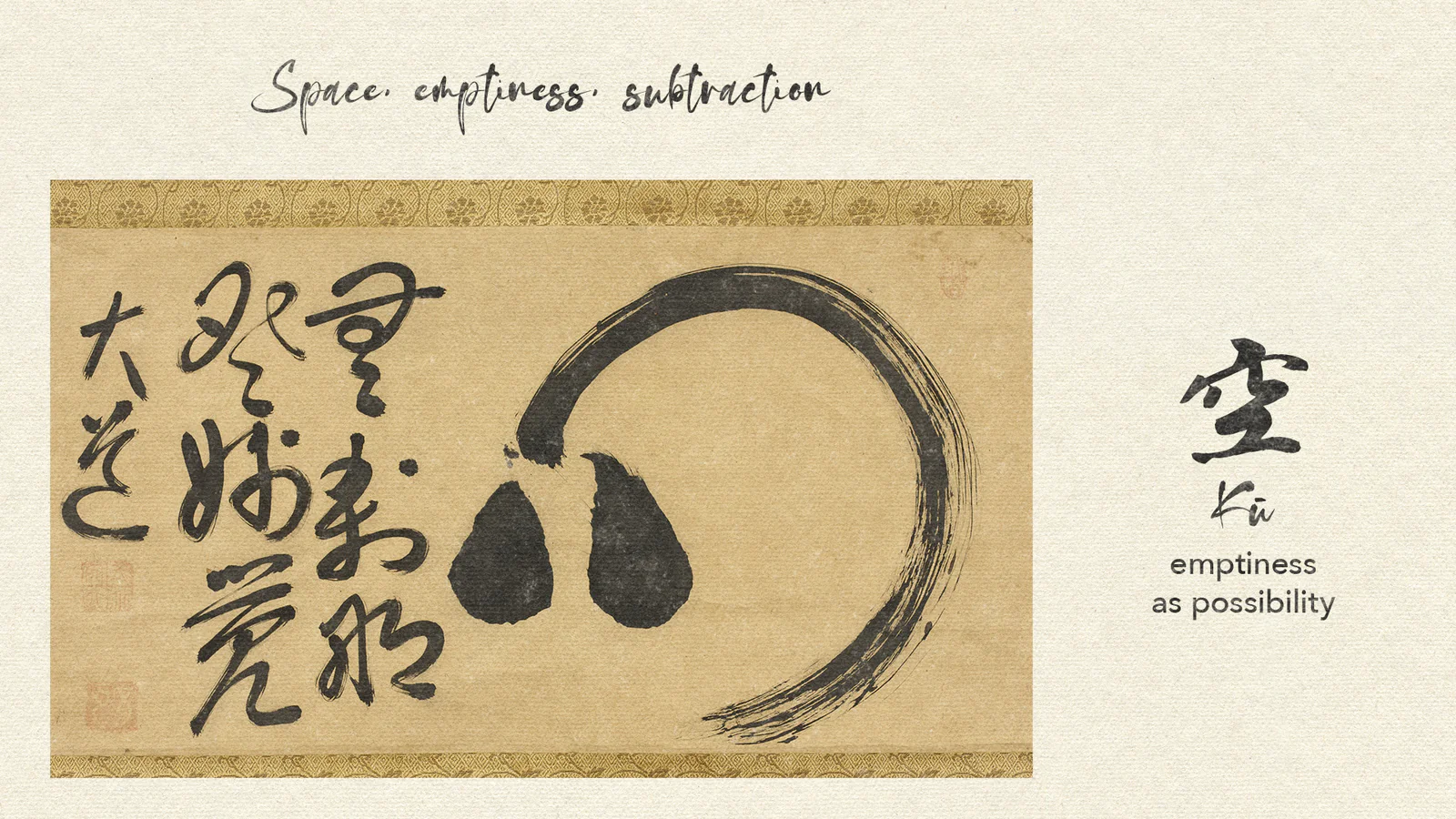
Daidō Bunka, The Character for Heart-Mind as an Ensō (LACMA M.84.211.1) | Daidō Bunka, public domain, via Wikimedia Commons (LACMA)
Kū (空) is emptiness as possibility: open, boundless and full of potential. It is also the fifth ring, the Void, in Miyamoto Musashi’s Book of Five Rings.
Kū (空) é o vazio como possibilidade: aberto, sem limite e cheio de potencial. É também o quinto anel, o Vazio, do Livro dos Cinco Anéis de Miyamoto Musashi.
Space, emptiness and subtraction — 無 Mu · letting go
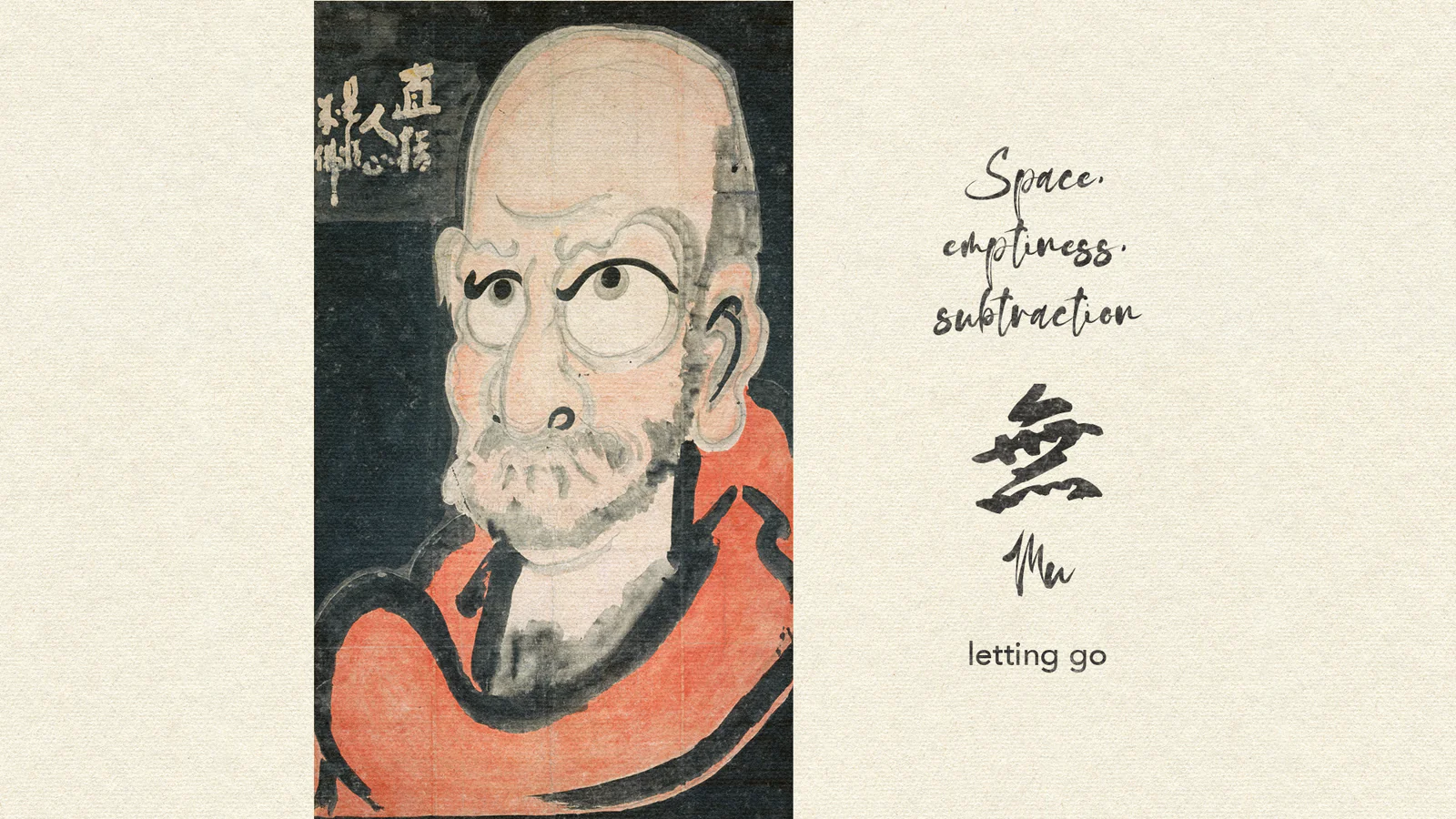
Hakuin Ekaku, Bodhidharma (Daruma) | Hakuin Ekaku, public domain, via Wikimedia Commons
Mu (無) is nothingness: letting go of excess to find clarity. Setting aside what is not needed does not impoverish, it frees room for what matters.
Mu (無) é o nada: largar o excesso para achar clareza. Deixar de lado o que não é necessário não empobrece, libera espaço para o que importa.
Space, emptiness and subtraction — 余白の美 Yohaku no Bi · beauty of white space
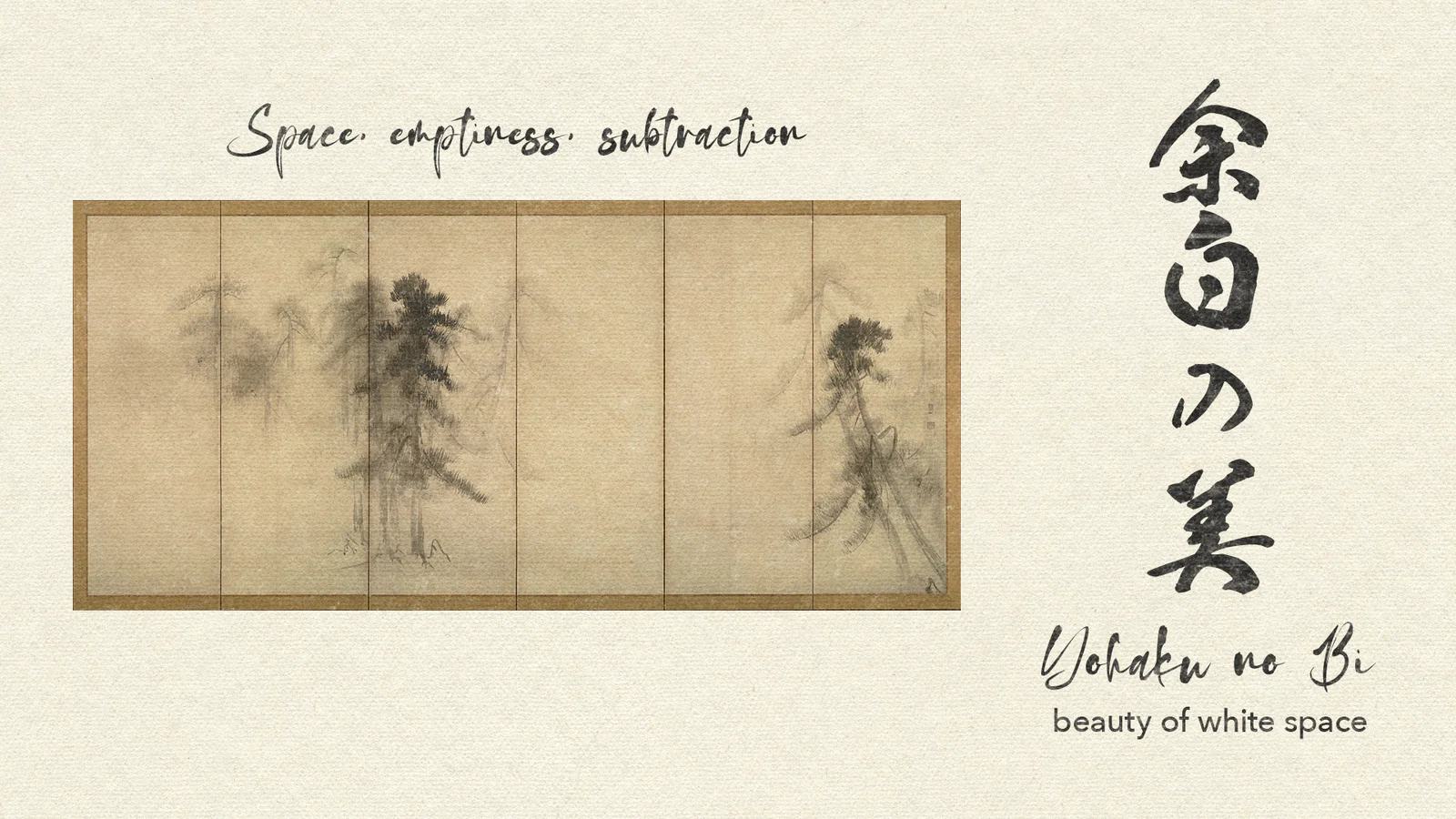
Hasegawa Tōhaku, Pine Trees | Hasegawa Tōhaku, public domain, via Wikimedia Commons (Google Art Project)
Yohaku no bi (余白の美) is the beauty of white space left on purpose. The idea came from Chinese ink painting, where mist and sky were left unpainted, and became a defining trait of Japanese art and design. The part of the page left unfilled is part of the composition.
Yohaku no bi (余白の美) é a beleza do espaço em branco deixado de propósito. A ideia veio da pintura em tinta chinesa, em que a névoa e o céu ficavam sem pintar, e virou traço marcante da arte e do design japoneses. A parte da página que não foi preenchida faz parte da composição.
Space, emptiness and subtraction — 引き算の美学 Hikizan no Bigaku · aesthetics of subtraction
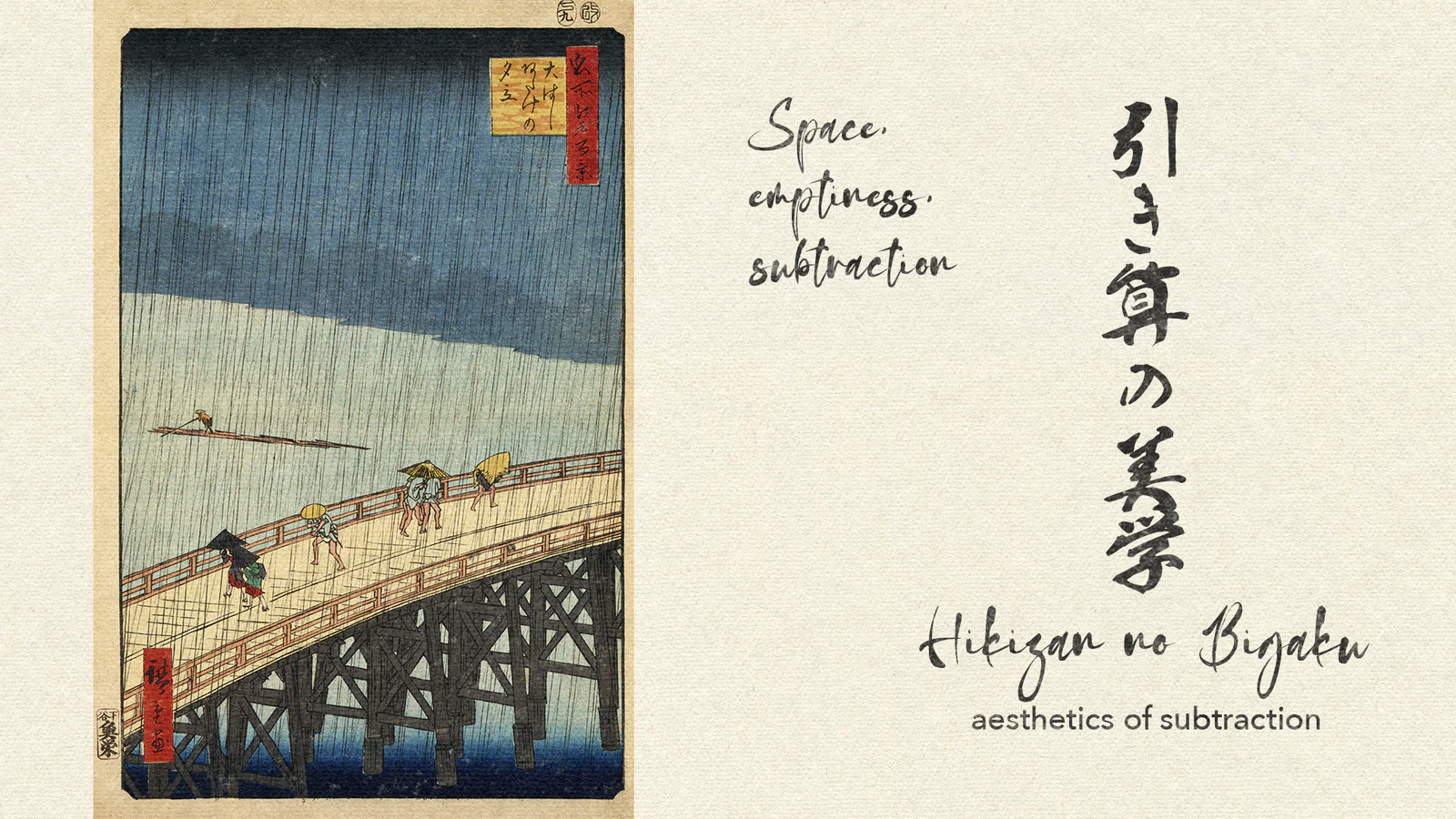
Hiroshige, Sudden shower over Shin-Ōhashi bridge and Atake (1857) | Utagawa Hiroshige, public domain, via Wikimedia Commons
Hikizan no bigaku (引き算の美学) is the aesthetics of subtraction. Instead of adding until the piece feels complete, the Japanese eye removes until it feels essential.
Hikizan no bigaku (引き算の美学) é a estética da subtração. Em vez de acrescentar até a peça ficar completa, o olhar japonês tira até ela ficar essencial.
Space, emptiness and subtraction — 借景 Shakkei · borrowed scenery
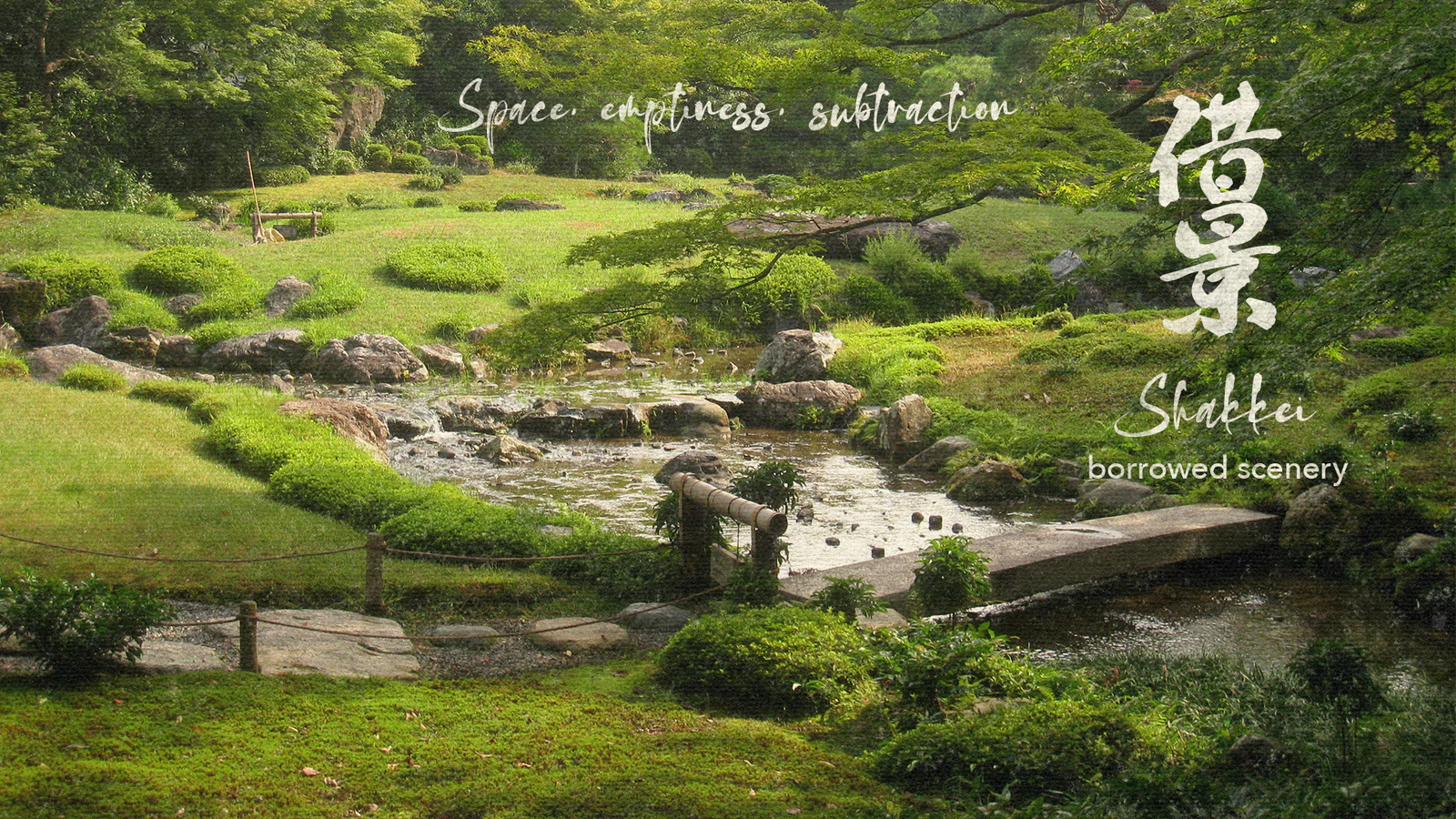
Murin-an, Kyoto (IMG 5104) | Photo: Daderot, public domain, via Wikimedia Commons
Shakkei (借景) is borrowed scenery: a distant mountain or tree is brought into the garden’s design as if it belonged to it. The term is Chinese in origin and appears in the 1635 treatise Yuanye. The best-known example is Entsū-ji in Kyoto, designed to frame Mount Hiei.
Shakkei (借景) é a paisagem emprestada: uma montanha ou uma árvore distante entra no projeto do jardim como se fizesse parte dele. O termo tem origem chinesa e aparece no tratado Yuanye, de 1635. O exemplo mais célebre é o Entsū-ji, em Kyoto, desenhado para emoldurar o monte Hiei.
Space, emptiness and subtraction — 粋 Iki · understated elegance
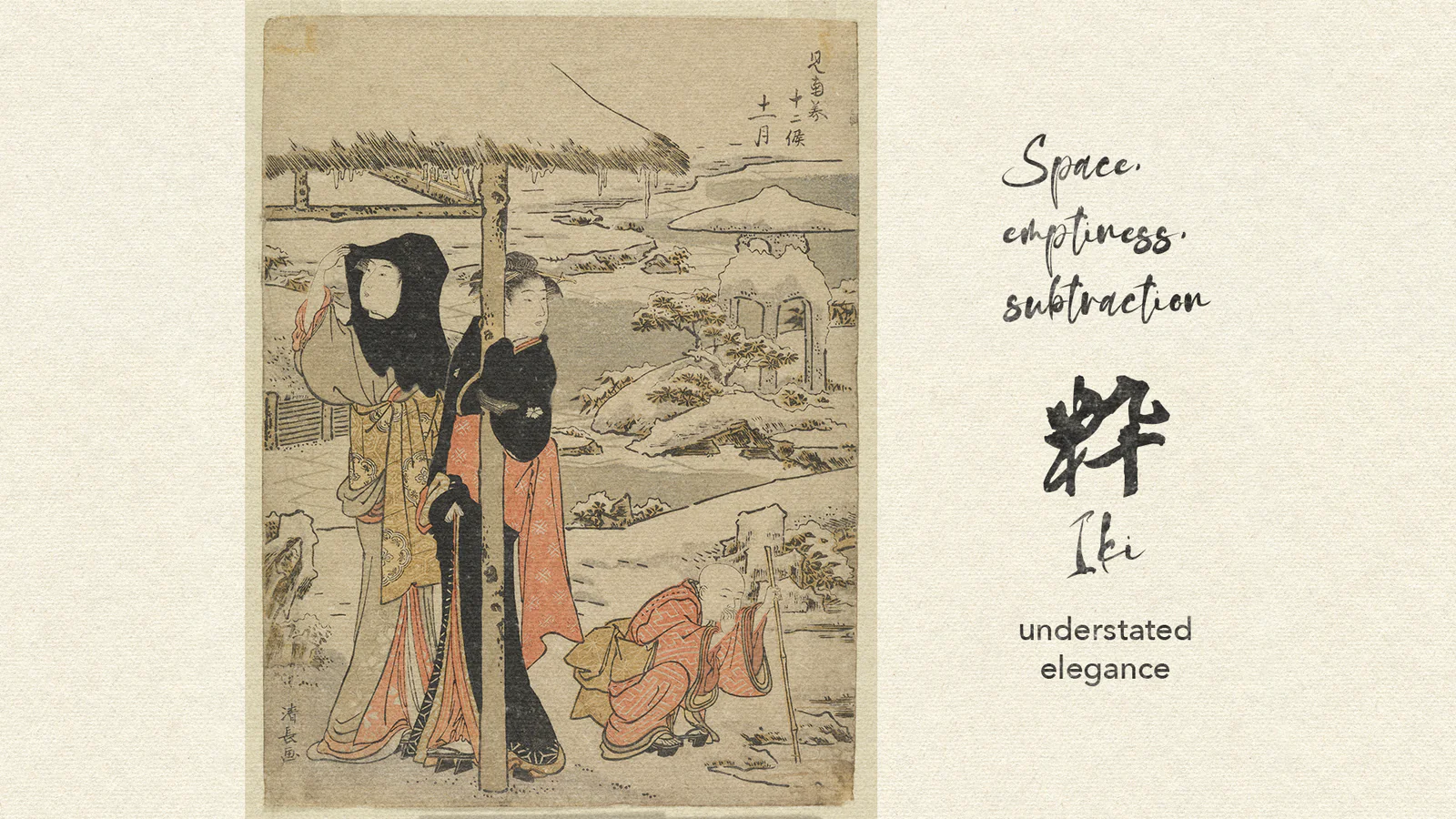
Torii Kiyonaga, Eleventh month (Jūichi gatsu) | Torii Kiyonaga, public domain, via Wikimedia Commons
Iki (粋) is understated, effortless elegance. It grew among Edo’s merchants as a refined style that does not need to announce itself. The philosopher Kuki Shūzō made it the subject of his 1930 analysis, The Structure of Iki (Iki no kōzō).
Iki (粋) é a elegância discreta, sem esforço aparente. Nasceu entre os comerciantes de Edo, como um estilo refinado que não precisa se anunciar. O filósofo Kuki Shūzō fez dele tema de análise em A Estrutura do Iki (Iki no kōzō), de 1930.
Space, emptiness and subtraction — 室礼 Shitsurai · arranging space with care
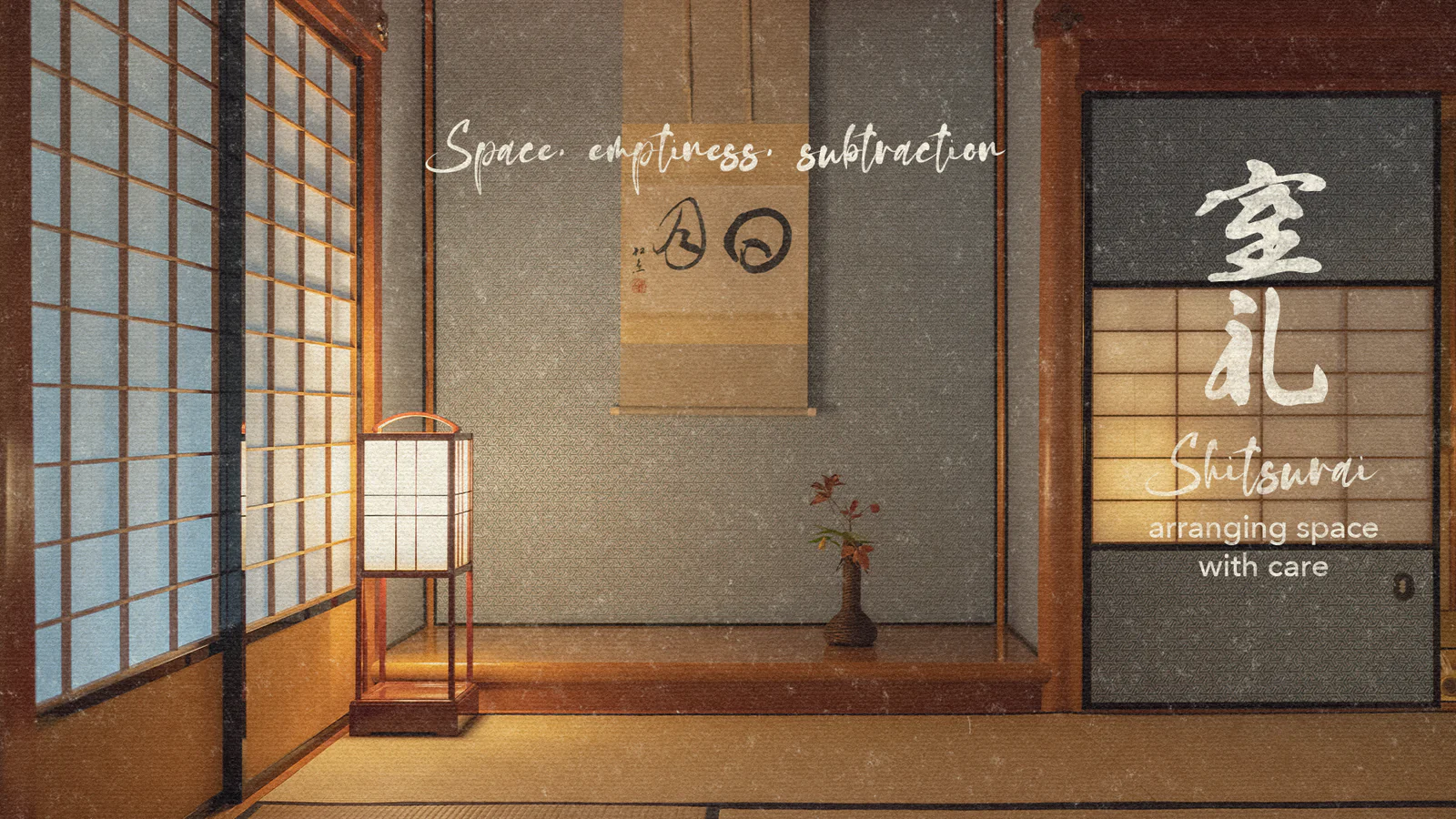
Tatami Alcove (45063444665) | Photo: Benh LIEU SONG, CC BY-SA 2.0, via Wikimedia Commons
Shitsurai (室礼) is arranging a space with care and meaning. It is a Heian-era term for setting up a room with furnishings and objects for banquets and ceremonies. The practice was later refined in the tokonoma, the alcove where a scroll is hung and flowers are placed.
Shitsurai (室礼) é dispor um espaço com cuidado e sentido. É um termo da era Heian para arrumar uma sala com móveis e objetos para banquetes e cerimônias. Depois, a prática se refinou no tokonoma, a alcova onde se pendura um rolo e se põem flores.
Space, emptiness and subtraction — 余韻 Yoin · lingering feeling
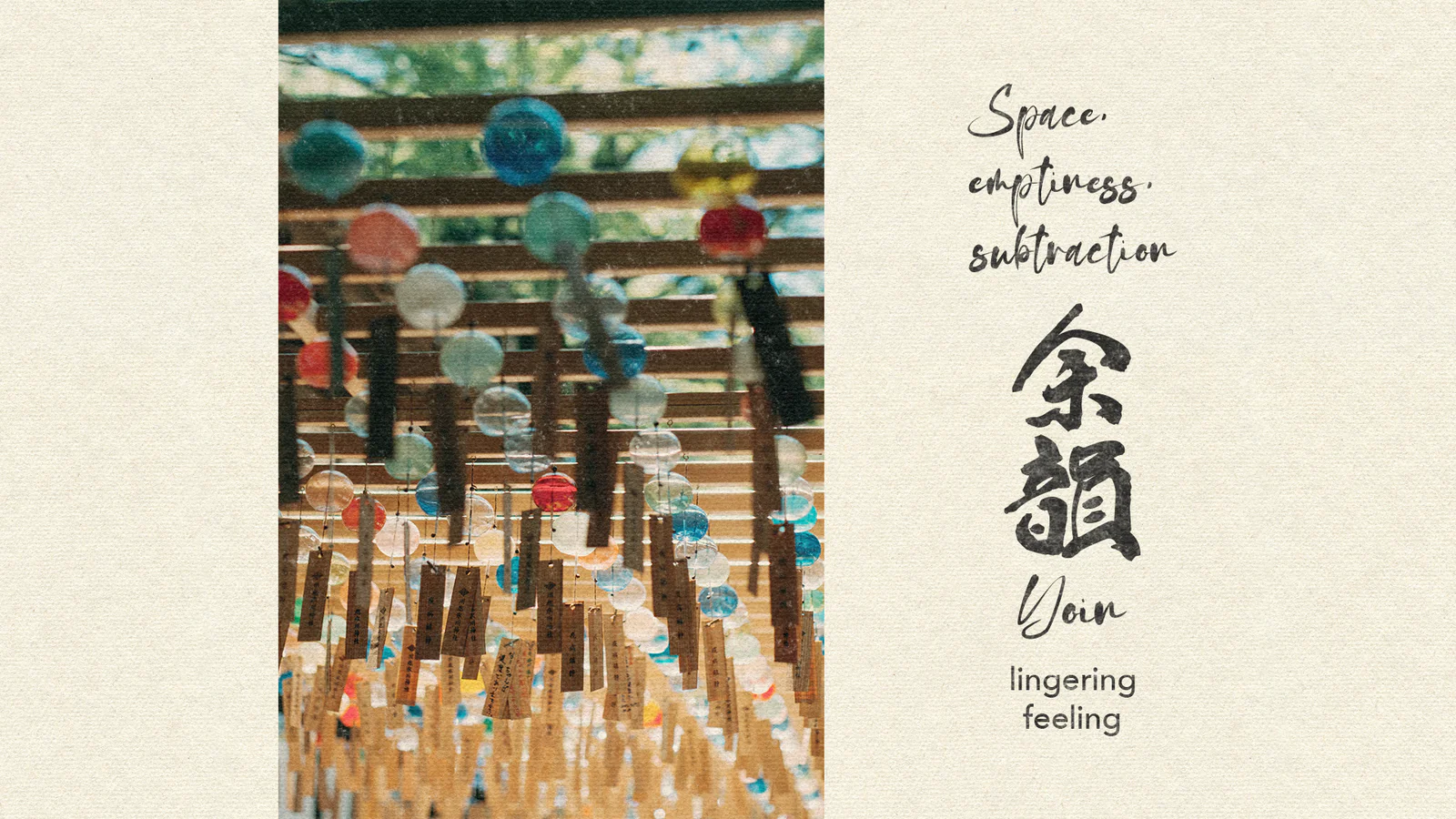
Photo: wenchengphoto, via Pexels
Yoin (余韻) is the resonance that stays after the moment ends. Literally, it means leftover sound: the bell that keeps humming after the strike. Figuratively, it is the feeling or mood that lingers after a film, a concert or a meal.
Yoin (余韻) é a ressonância que fica depois que o momento acaba. Literalmente, quer dizer som que sobra: o sino que continua vibrando depois da batida. Em sentido figurado, é a sensação ou o clima que permanece depois de um filme, de um concerto ou de uma refeição.
Impermanence and imperfection · 無常と不完全
Impermanence and imperfection — 物の哀れ Mono no aware · gentle sadness at passing things
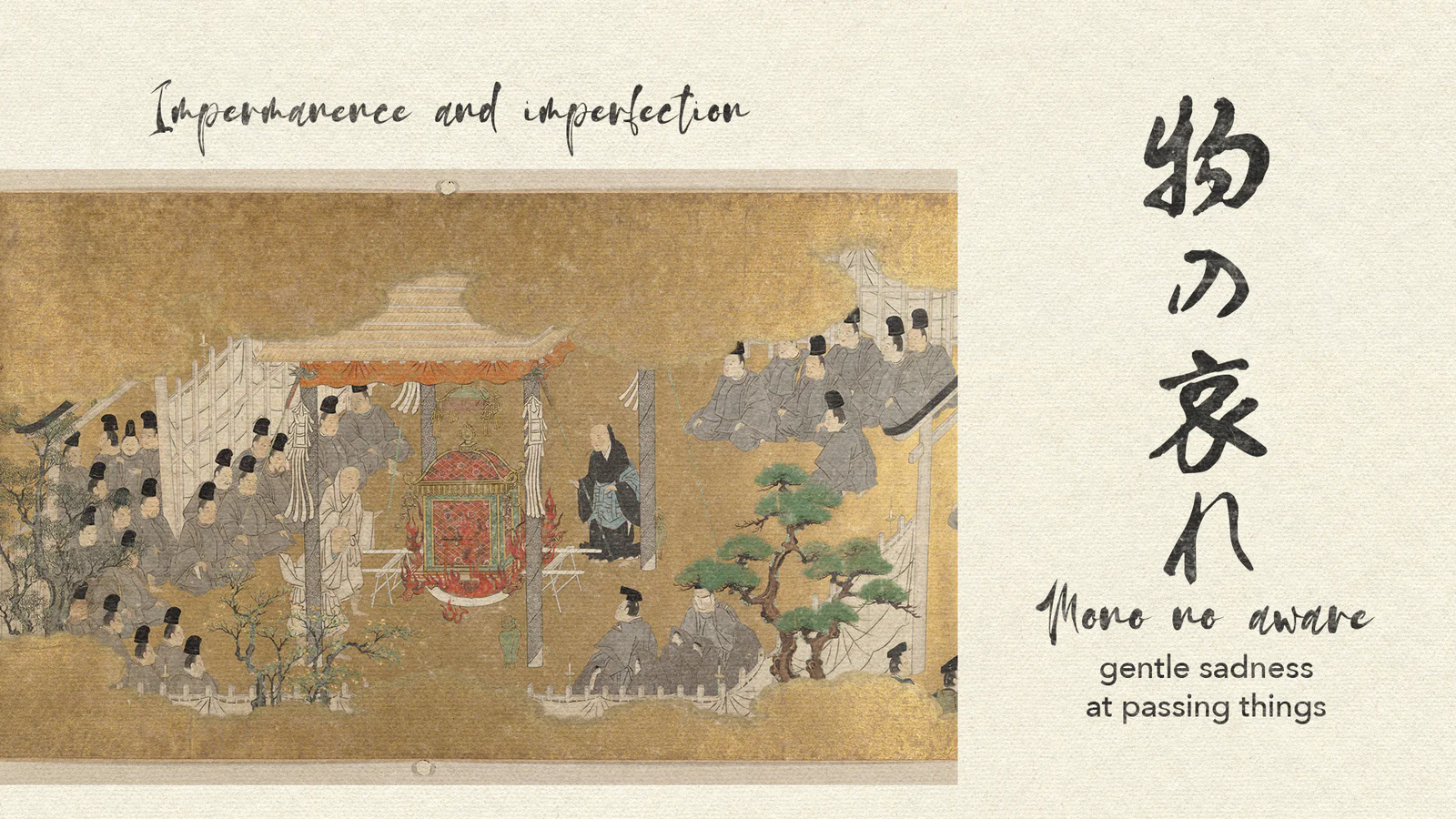
Scene from the Tale of Genji (Genji monogatari e-maki), MET DP214436 | Kyo-Kano School, CC0, via Wikimedia Commons (The Met)
Mono no aware (物の哀れ) is gentle sadness at passing things: a moved sensitivity to the fleeting nature of things, with a bittersweet tenderness. The phrase comes from Heian-era literature and became a central concept through the scholar Motoori Norinaga (1730–1801), in his reading of The Tale of Genji. Despite the kanji 哀, the idea is broader than sadness: it is being deeply moved, including by joy and love. Cherry blossoms, beautiful because they are brief, are the classic example.
Mono no aware (物の哀れ) é a doce tristeza do que passa: uma sensibilidade comovida diante da fugacidade das coisas, com ternura agridoce. A expressão vem da literatura da era Heian e virou conceito central com o estudioso Motoori Norinaga (1730–1801), ao ler o Genji Monogatari. Apesar do kanji 哀, a ideia é mais ampla que tristeza: é ser profundamente tocado, inclusive pela alegria e pelo amor. A cerejeira em flor, bela por ser breve, é o exemplo clássico.
Impermanence and imperfection — 渋い Shibui · beauty in restraint
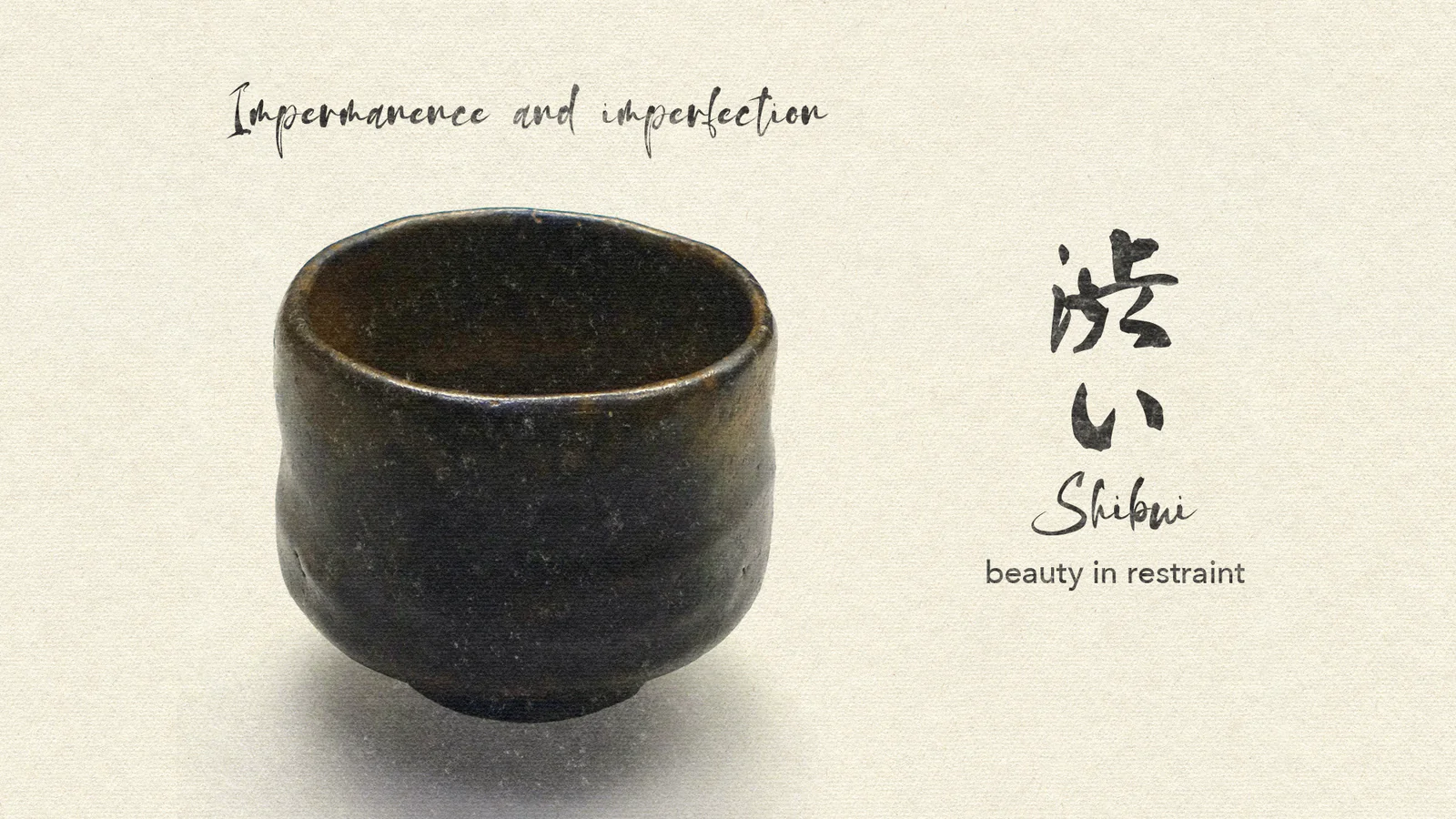
Tea bowl, known as Suehiro, studio of Chōjirō, Raku ware, Kuroraku type | Photo: Daderot, CC0, via Wikimedia Commons (Tokyo National Museum)
Shibui (渋い) is simple, subtle beauty, understated rather than showy. It comes from a word for a sour, astringent taste, like that of an unripe persimmon, and is the opposite of amai (sweet). A shibui object looks simple at first but reveals textures and details, so interest grows with time. Not every shibui object is wabi-sabi, and not every wabi-sabi object is shibui.
Shibui (渋い) é a beleza simples e sutil, discreta em vez de chamativa. Vem de uma palavra para o gosto azedo e adstringente, como o do caqui verde, e é o oposto de amai (doce). O objeto shibui parece simples à primeira vista, mas revela texturas e detalhes, e por isso o interesse cresce com o tempo. Nem todo objeto shibui é wabi-sabi, e nem todo wabi-sabi é shibui.
Impermanence and imperfection — 金継ぎ Kintsugi · golden joinery
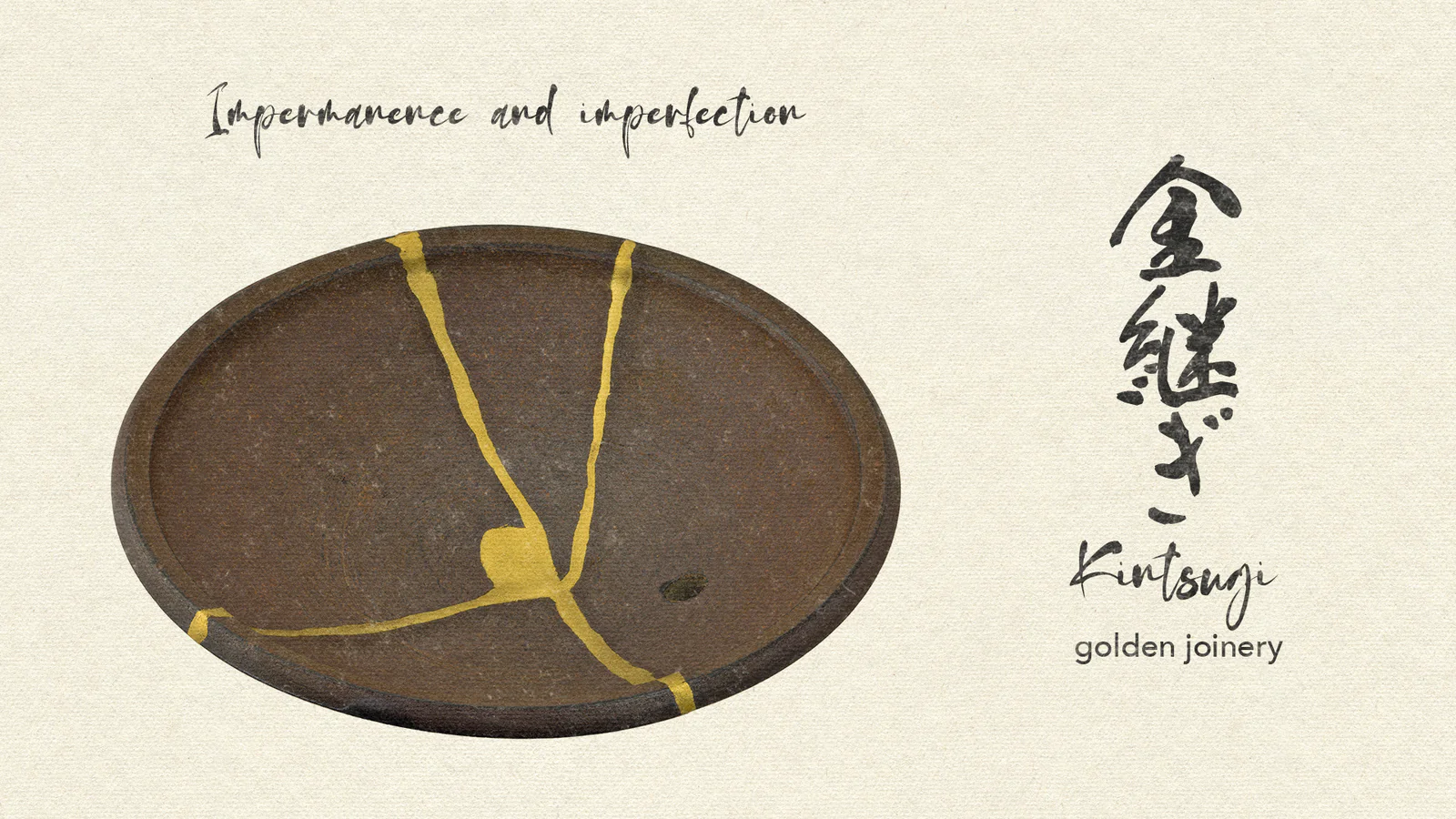
Kintsugi on broken Kyūsu lid-bottom, oblique (PNr°1260) | Photo: D-Kuru, CC BY-SA 4.0, via Wikimedia Commons
Kintsugi (金継ぎ), golden joinery, is repairing broken pottery with urushi lacquer mixed or dusted with gold, silver or platinum powder, so that the break becomes part of the object’s history. Also called kintsukuroi (金繕い). The origin is uncertain; the most told story involves the shogun Ashikaga Yoshimasa (1436–1490) and a Chinese celadon bowl mended with metal staples. The technique became tied to the tea ceremony and has returned to fashion in recent decades.
Kintsugi (金継ぎ), a junção dourada, é consertar cerâmica quebrada com laca urushi misturada ou polvilhada com pó de ouro, prata ou platina, de modo que a quebra vire parte da história do objeto. Também chamado kintsukuroi (金繕い). A origem é incerta; a história mais contada envolve o xogum Ashikaga Yoshimasa (1436–1490) e uma tigela chinesa de celadon remendada com grampos de metal. A técnica ficou ligada à cerimônia do chá e voltou à moda nas últimas décadas.
Impermanence and imperfection — 蒔絵 Maki-e · metallic powder on lacquer
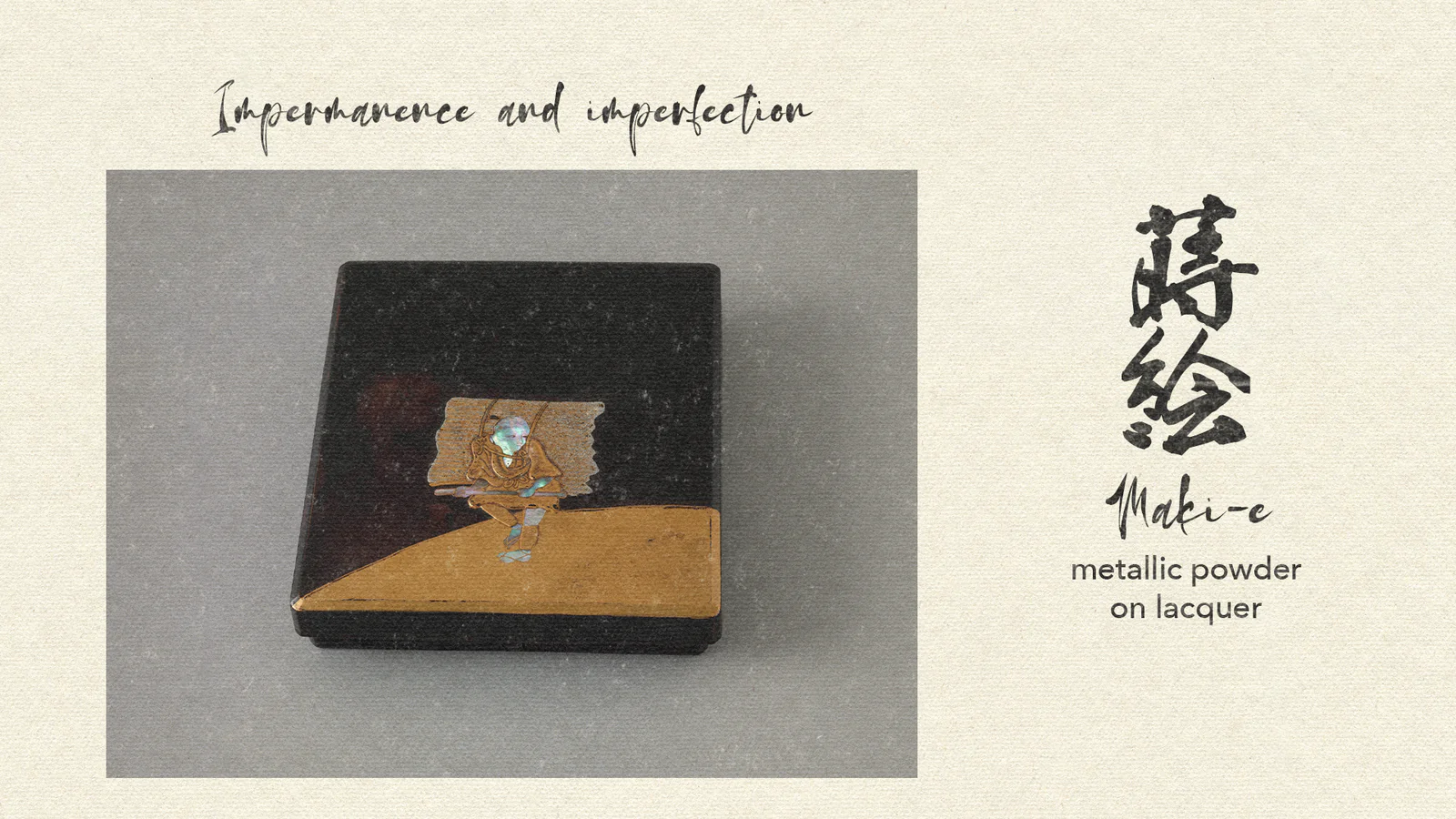
Writing Box (Suzuribako) with Woodcutter, MET DP271826 | Ogata Kōrin (atribuição do Commons), CC0, via Wikimedia Commons (The Met)
Maki-e (蒔絵), literally sprinkled picture, is the decorative technique of drawing with lacquer and dusting metallic powder over the still-wet surface. It began in the Heian period and flourished in the Edo period. It is a close relative of kintsugi: the shine of metal on dark lacquer is part of the design.
Maki-e (蒔絵), literalmente imagem polvilhada, é a técnica decorativa de desenhar com laca e polvilhar pó metálico sobre a superfície ainda úmida. Nasceu na era Heian e floresceu no período Edo. É parente próxima do kintsugi: o brilho do metal sobre a laca escura é parte do desenho.
Impermanence and imperfection — 葉狩り Momijigari · hunting autumn leaves
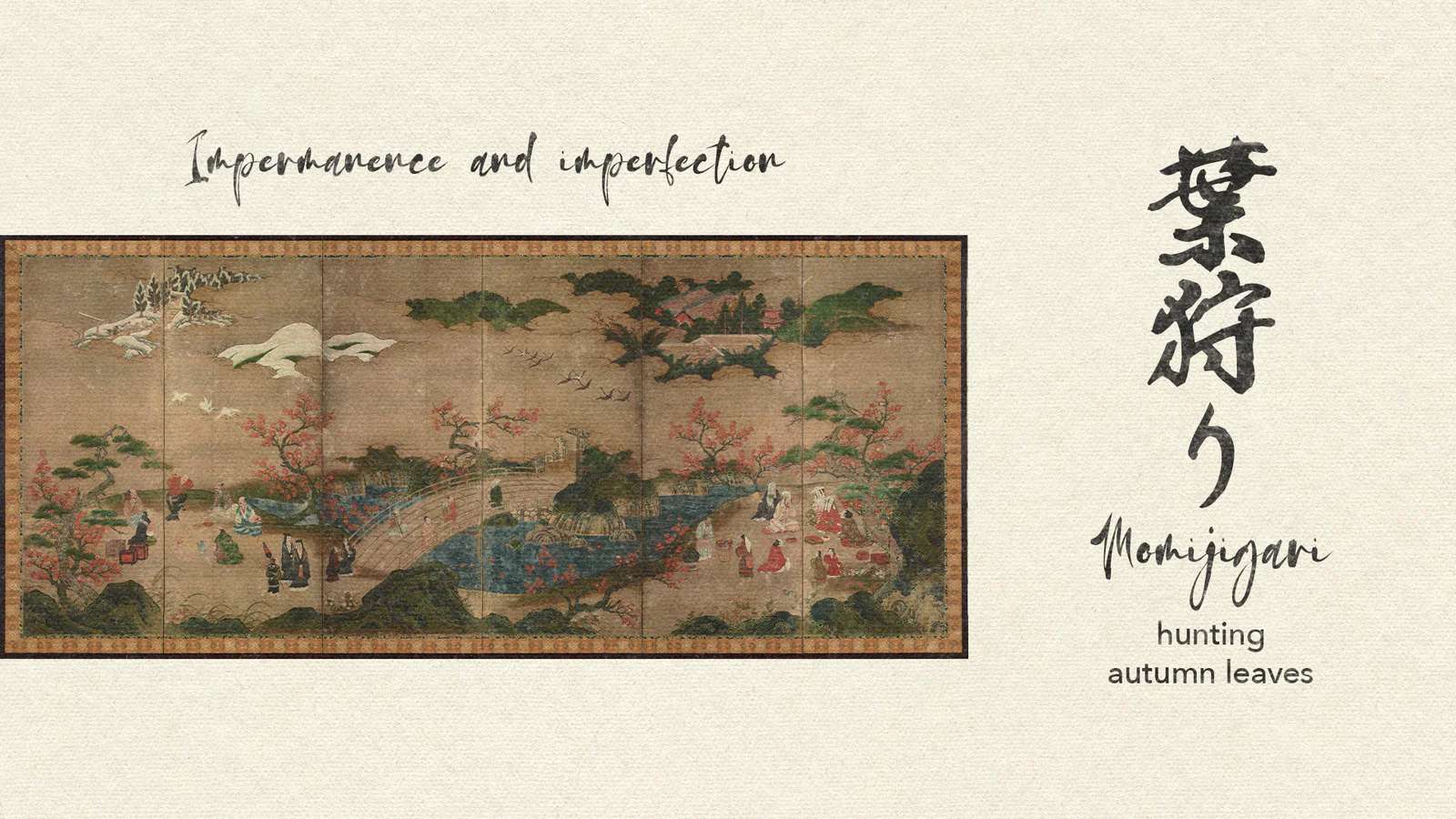
Maple viewers | Kanō Hideyori, public domain, via Wikimedia Commons
Momijigari (紅葉狩り) is the tradition of going out to admire autumn foliage. The suffix -gari means hunting, but nothing is picked here: it is pure looking. Records go back to the 10th century, when Heian aristocrats took boat trips, composed poems and gathered colorful leaves; in the Edo period the custom opened up to everyone. If spring’s cherry blossoms signal renewal, autumn invites introspection.
Momijigari (紅葉狩り) é a tradição de sair para apreciar a folhagem de outono. O sufixo -gari quer dizer caçar, mas aqui nada é colhido: é só olhar. Os registros remontam ao século X, quando aristocratas da era Heian passeavam de barco, compunham poemas e juntavam folhas coloridas; no período Edo, o costume se abriu a todos. Se as cerejeiras da primavera sinalizam renovação, o outono convida à introspecção.
Craft and use · 工芸と用
Craft and use — 用の美 Yo no Bi · beauty of utility
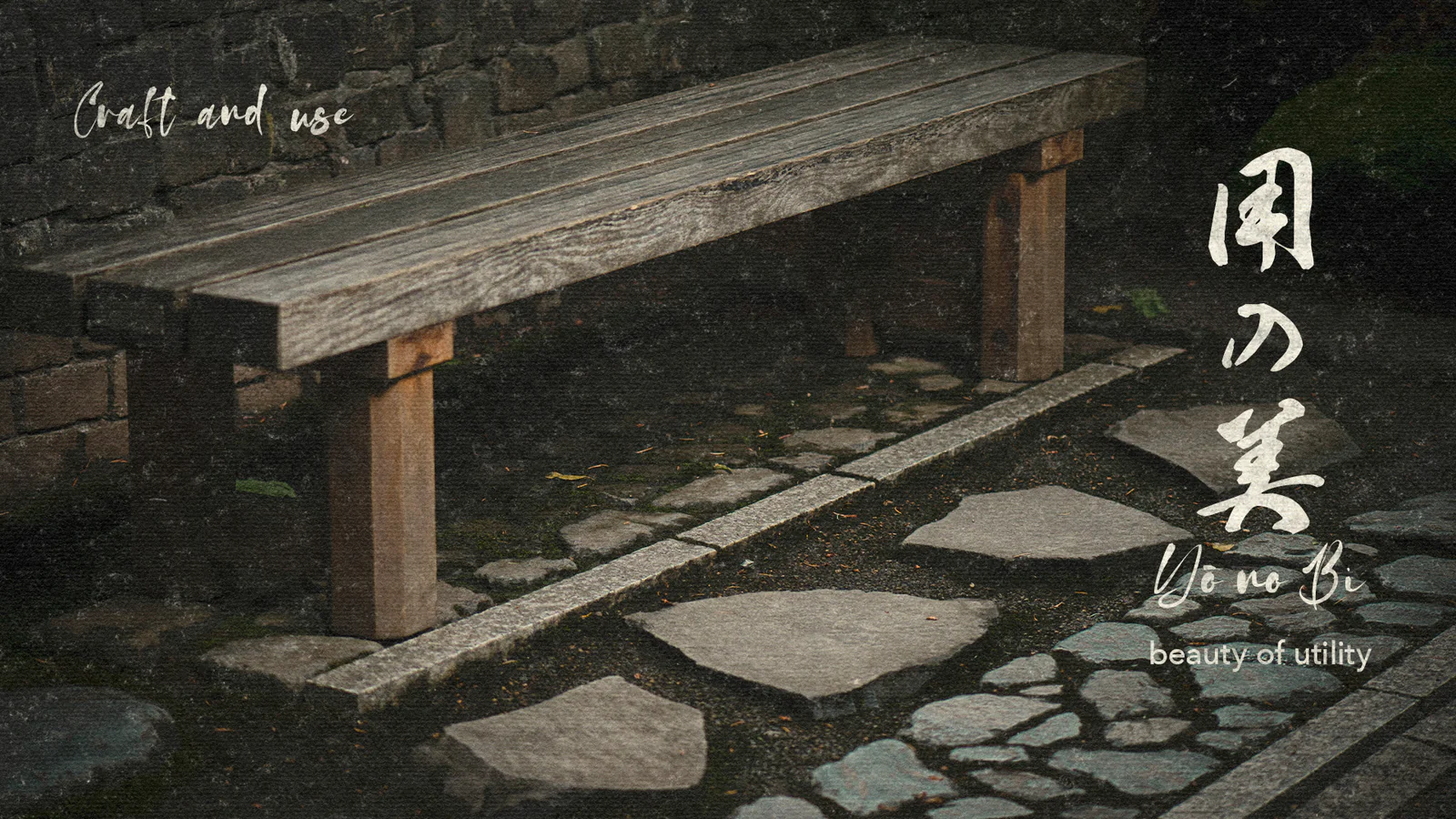
Photo: Kevin Butz, via Unsplash (unsplash.com/photos/8joueVpli08)
Yō no bi (用の美) is the beauty of utility: an object made to be used is beautiful in use. The concept is tied to Yanagi Sōetsu and the mingei (folk craft) movement, born in 1926. It is not plain functionalism: it recognizes the beauty of forms shaped by the practical needs of generations.
Yō no bi (用の美) é a beleza da utilidade: o objeto feito para ser usado é belo no uso. O conceito está ligado a Yanagi Sōetsu e ao movimento mingei (artesanato popular), nascido em 1926. Não é funcionalismo puro: reconhece a beleza de formas moldadas pelas necessidades práticas de gerações.
Craft and use — 物作り Monozukuri · the spirit of craftsmanship
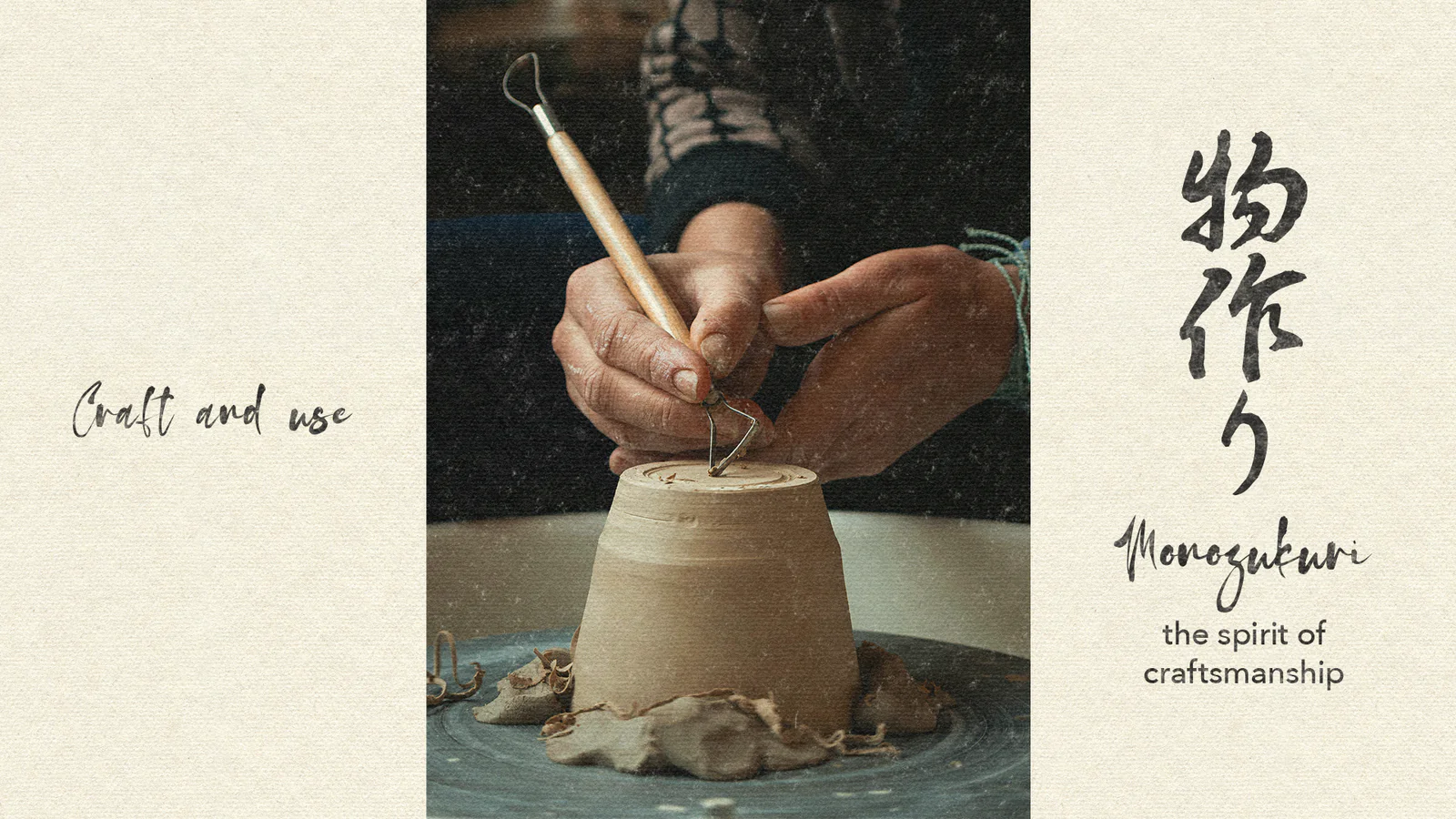
Photo: Aedrian Salazar, via Unsplash (unsplash.com/photos/BshM9VkzGw8)
Monozukuri (物作り) literally means making things, and is the spirit of craftsmanship: attention to detail, dedication, pride and humility. Since the late 1990s, the word has also come to mean Japan’s manufacturing industry, and is now used almost as a national slogan.
Monozukuri (物作り) quer dizer, literalmente, fazer coisas, e é o espírito do ofício: atenção ao detalhe, dedicação, orgulho e humildade. Desde o fim dos anos 1990, a palavra também passou a designar a indústria de manufatura japonesa, e hoje é usada quase como um slogan nacional.
Craft and use — 勿体無い Mottainai · regret at waste
Child’s Sleeping Mat (boro Shikimono), late 19th century (CH 1108827543) | Unknown artist, public domain, via Wikimedia Commons
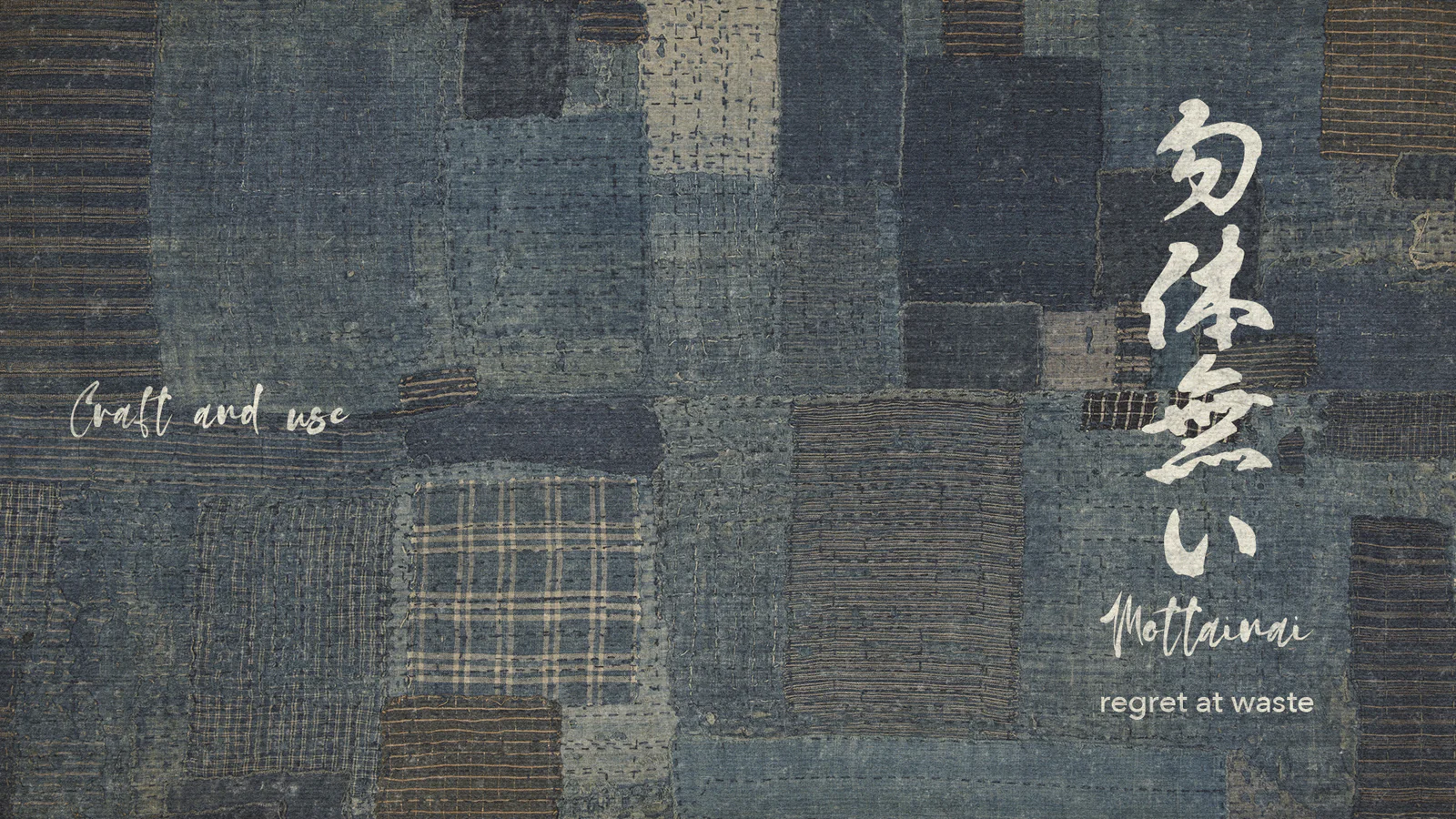
Mottainai (勿体無い) is the regret felt when something valuable is wasted: food, time, effort, an object with life left in it. The word joins mottai (a thing’s dignity or inherent value, according to sources) and nai (there is none). Use goes back to the 13th century. In 2005, the Kenyan activist Wangari Maathai took it to the world as an environmental slogan, adding respect to the three Rs: reduce, reuse, recycle.
Mottainai (勿体無い) é o lamento quando algo valioso é desperdiçado: comida, tempo, esforço, um objeto que ainda tinha vida útil. A palavra junta mottai (a dignidade ou o valor próprio de uma coisa, segundo as fontes) e nai (não há). O uso remonta ao século XIII. Em 2005, a ativista queniana Wangari Maathai a levou ao mundo como slogan ambiental, somando o respeito aos três R: reduzir, reutilizar, reciclar.
The way of tea · 茶道
The way of tea — 茶道 Chadō · the way of tea
Maccha cup | Photo: Japanexperterna.se, CC BY-SA 3.0, via Wikimedia Commons
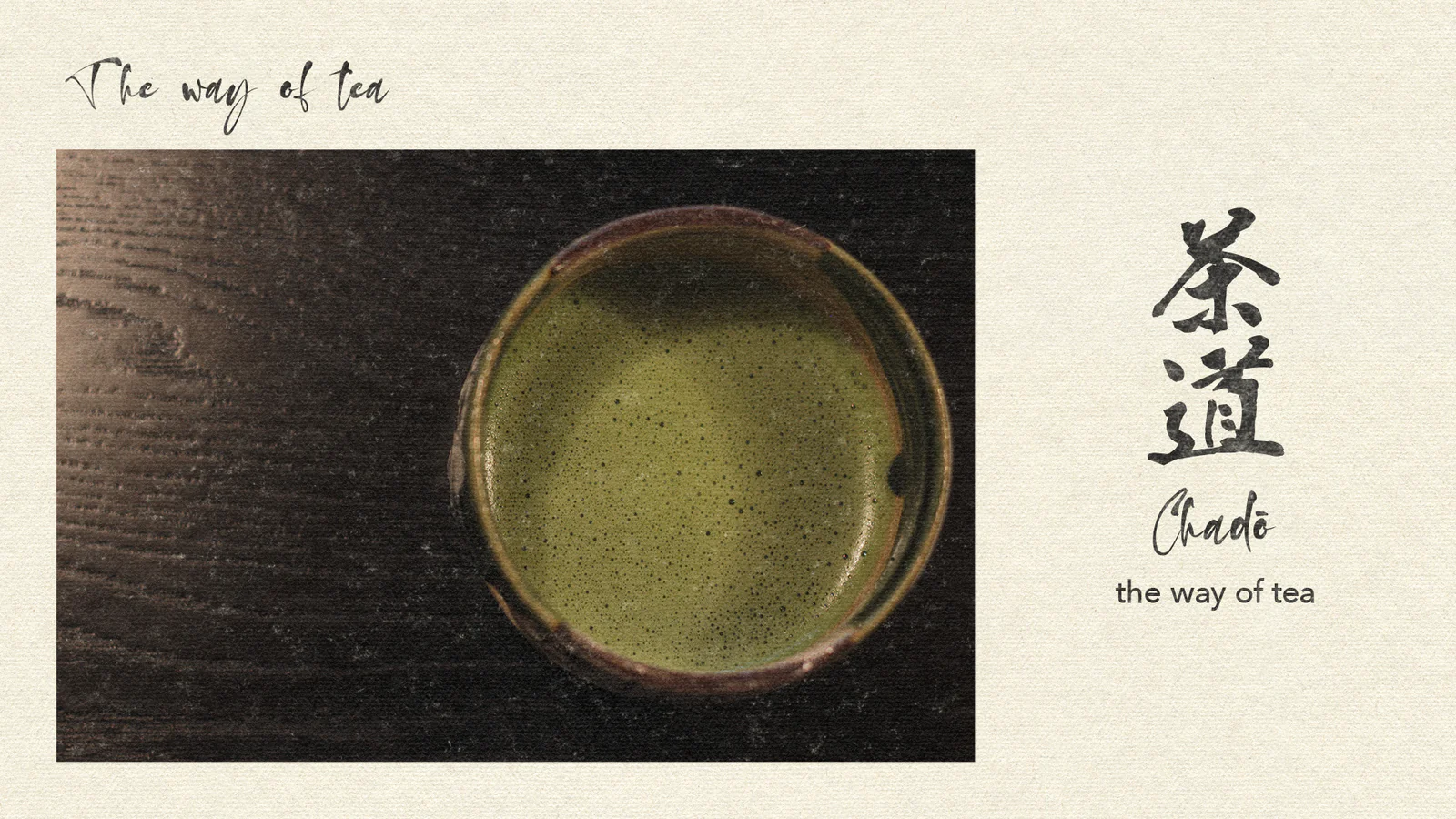
Chadō (茶道), the way of tea, also called chanoyu (茶の湯, hot water for tea), is the ritual preparation and offering of matcha. Every gesture is made with attention, and the meeting matters more than the drink. Four principles sum it up: wa, kei, sei and jaku (和敬清寂).
Chadō (茶道), o caminho do chá, também chamado chanoyu (茶の湯, água quente para o chá), é o preparo e a oferta ritual do matcha. Cada gesto é feito com atenção, e o encontro importa mais que a bebida. Quatro princípios o resumem: wa, kei, sei e jaku (和敬清寂).
The way of tea — 点前 Temae · the method of preparation
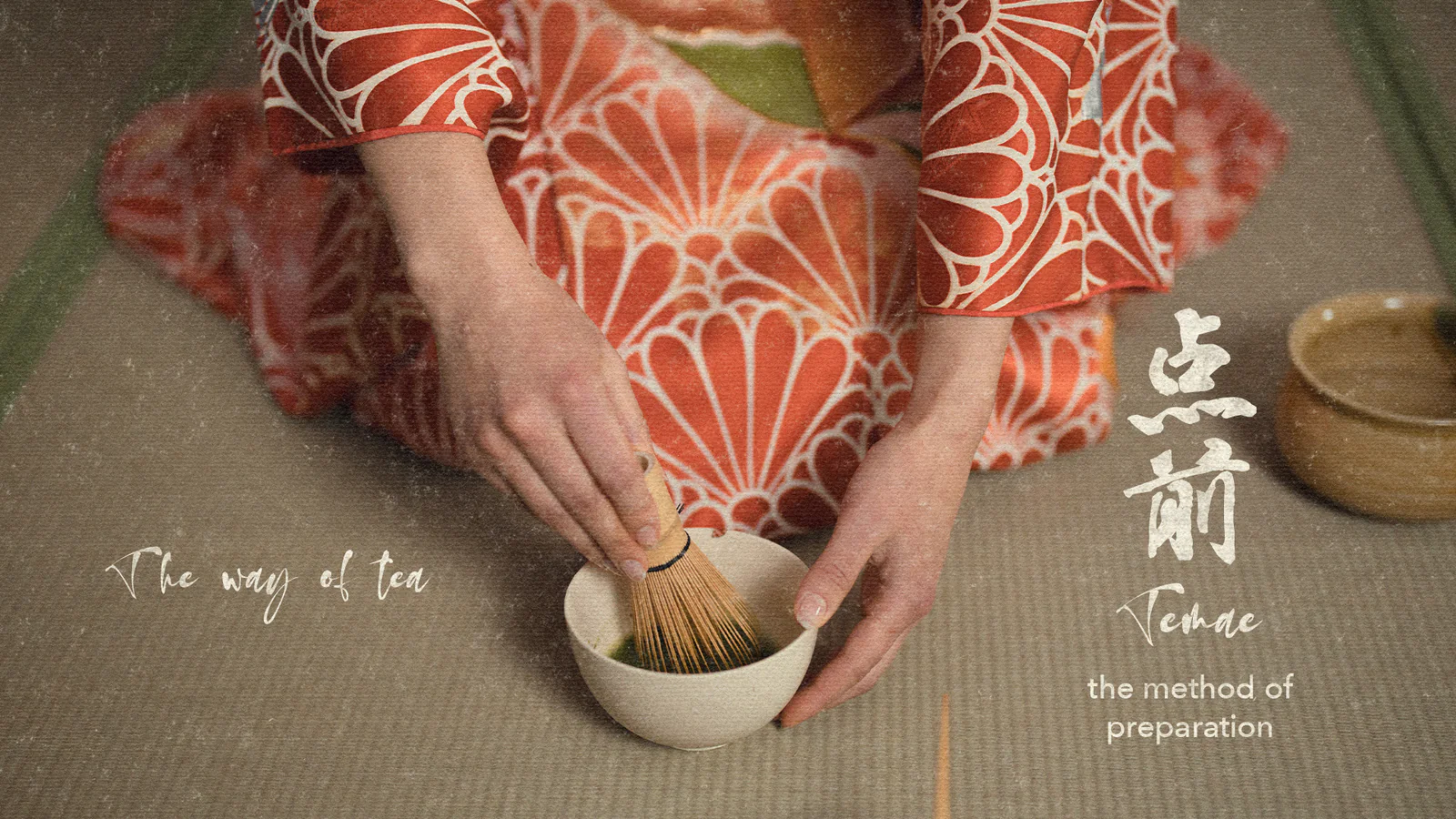
Photo: cottonbro, via Pexels
Temae (点前) is the method of preparing tea: the sequence of gestures, from cleaning the utensils to handing over the bowl. The way is practiced in the detail repeated with care.
Temae (点前) é o método de preparo do chá: a sequência de gestos, da limpeza dos utensílios à entrega da tigela. É no detalhe repetido com cuidado que o caminho se pratica.
The way of tea — 和 Wa · harmony
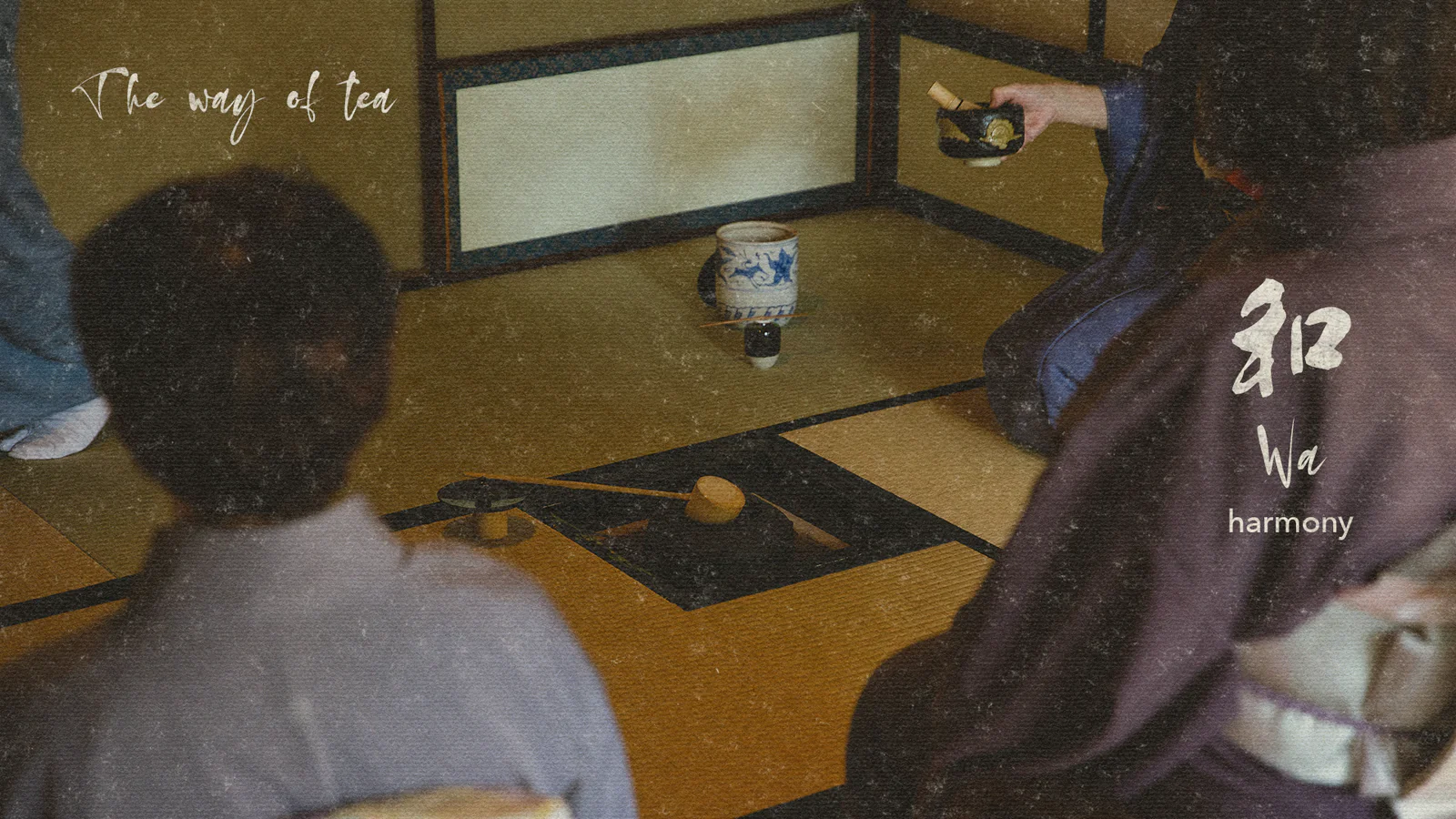
Photo: ryutaro, via Pexels
Wa (和) is harmony, the first of the four principles of tea (和敬清寂), mostly credited to Sen no Rikyū, though some sources point to his predecessor Murata Jukō. It is also the word used for Japan itself and for what is Japanese.
Wa (和) é harmonia, o primeiro dos quatro princípios do chá (和敬清寂), atribuídos sobretudo a Sen no Rikyū, embora algumas fontes apontem seu predecessor Murata Jukō. Também é a palavra que designa o próprio Japão e o que é japonês.
The way of tea — 敬 Kei · respect
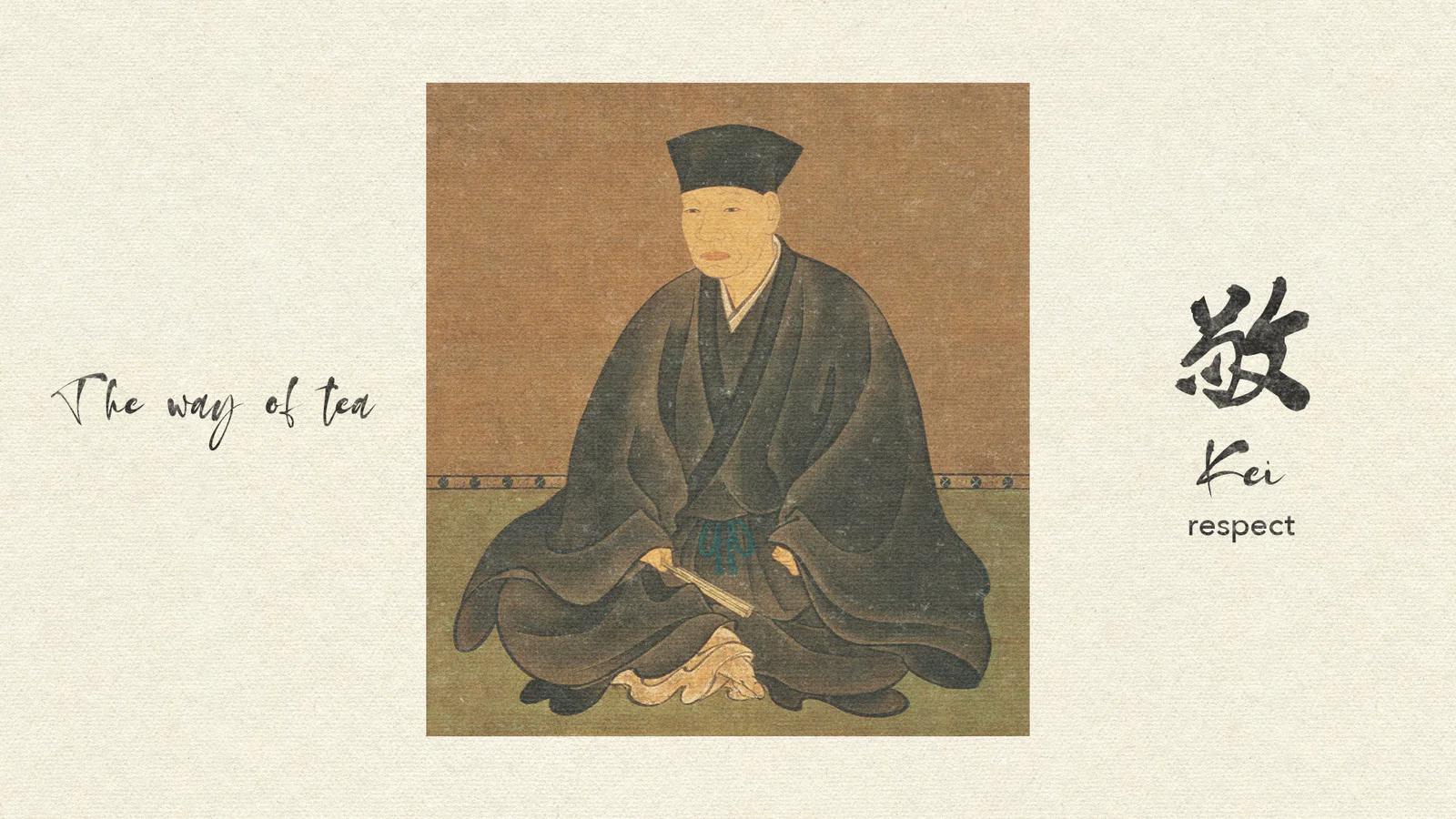
Sen no Rikyū (cropped) | Hasegawa Tōhaku (pintura) e Shun’oku Sōen (caligrafia), public domain, via Wikimedia Commons
Kei (敬) is respect, the second principle of tea. Respect for the guests, for the utensils, and for the moment being lived.
Kei (敬) é respeito, o segundo princípio do chá. Respeito pelos convidados, pelos utensílios e pelo momento que se está vivendo.
The way of tea — 清 Sei · purity
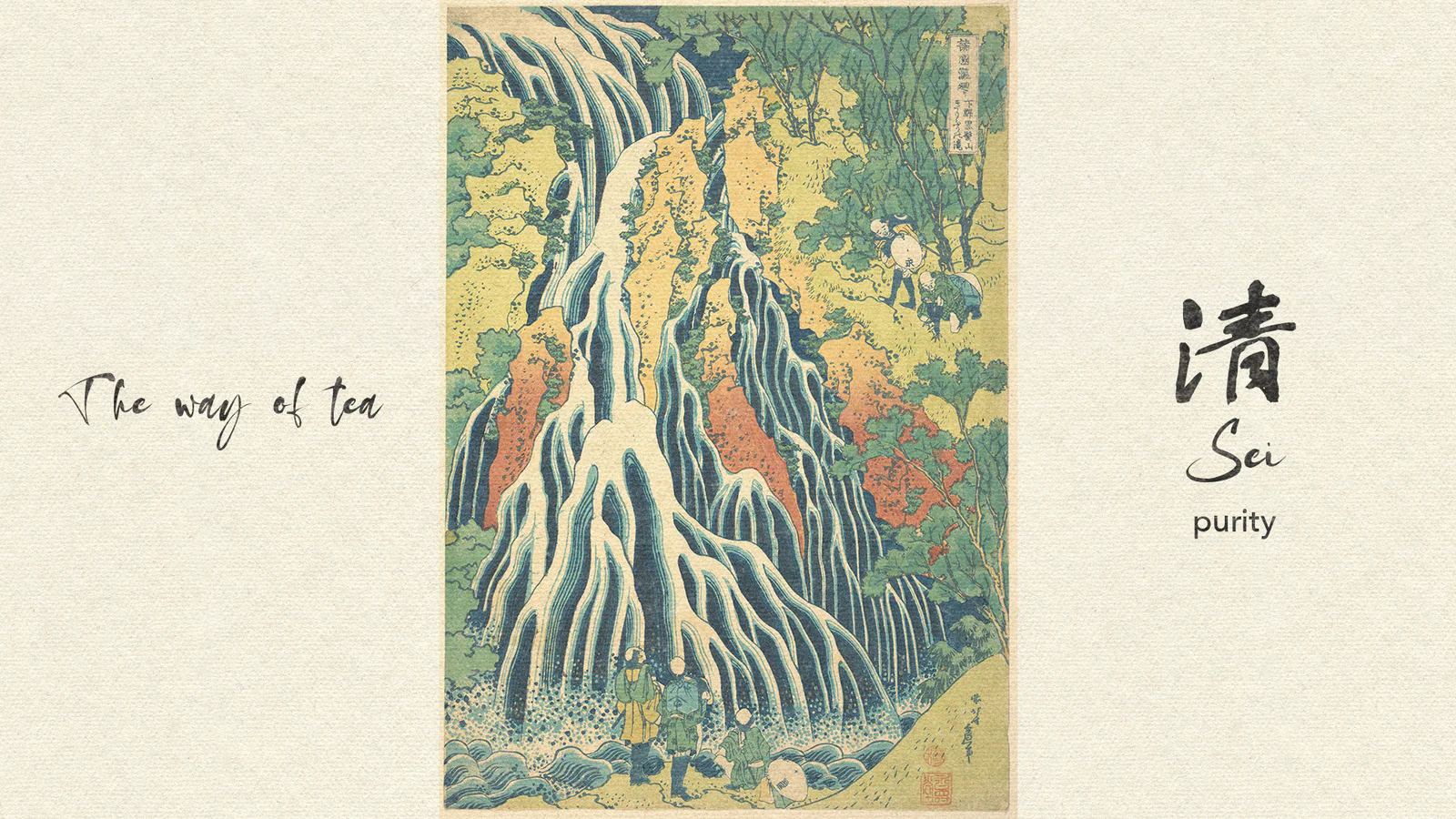
Kirifuri Waterfall at Kurokami Mountain in Shimotsuke, MET DP141256 | Katsushika Hokusai, CC0, via Wikimedia Commons (The Met)
Sei (清) is purity, the third principle of tea. Cleanliness of the space and the utensils, and also clarity of mind in the one who prepares and the one who receives.
Sei (清) é pureza, o terceiro princípio do chá. Limpeza do espaço e dos utensílios, e também clareza da mente de quem prepara e de quem recebe.
The way of tea — 寂 Jaku · tranquility
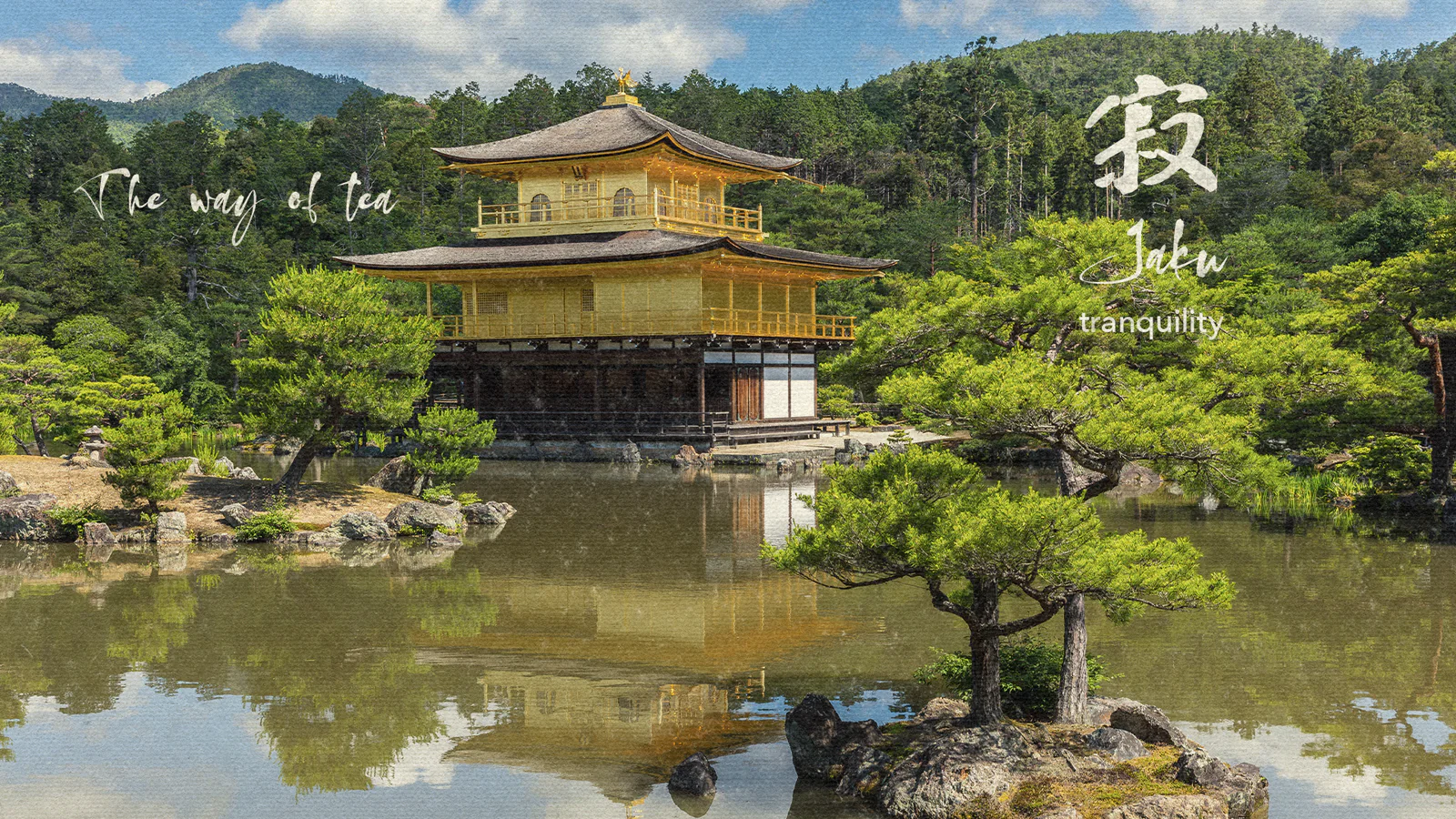
Water reflection of Kinkaku-ji Temple with a tree on a rock in the pond, Kyoto | Photo: Basile Morin, CC BY-SA 4.0, via Wikimedia Commons
Jaku (寂) is tranquility, the fourth principle of tea. It is not an effort: it is the natural result of practicing harmony, respect and purity. The same kanji appears in sabi and in seijaku.
Jaku (寂) é tranquilidade, o quarto princípio do chá. Não é um esforço: é o resultado natural de praticar a harmonia, o respeito e a pureza. O mesmo kanji aparece em sabi e em seijaku.
Proverbs & Principles · 諺と原則
Proverbs & Principles — 改善 Kaizen · change for the better
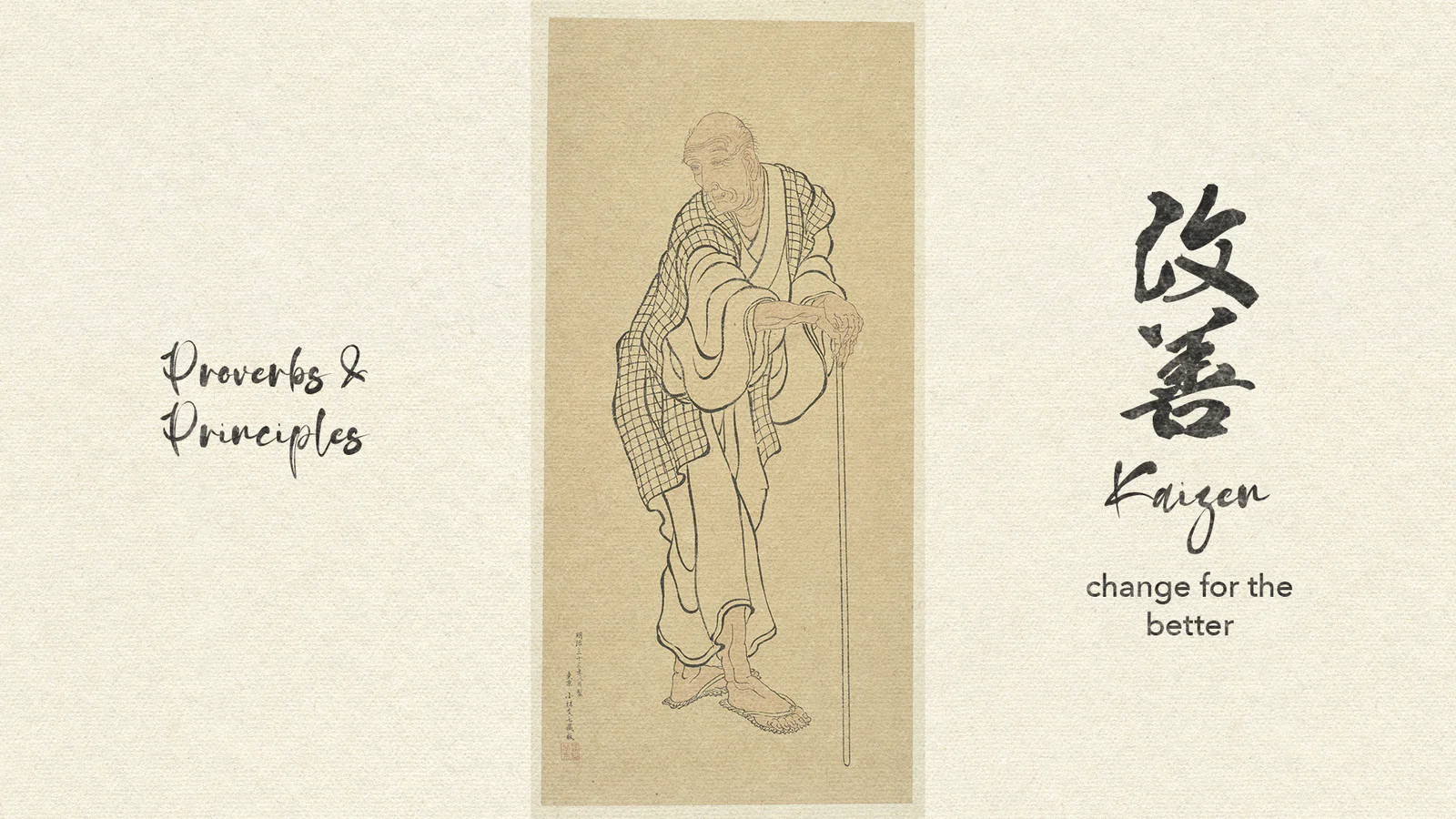
Hokusai as an old man | Autoria não identificada no Commons, CC0, via Wikimedia Commons
Kaizen (改善) means improvement, change for the better: 改 (change) and 善 (good). The word itself does not mean continuous; that idea came from postwar Japanese management, especially Toyota, which made kaizen a philosophy of small daily improvements. It is not a proverb but a principle.
Kaizen (改善) significa melhoria, mudança para melhor: 改 (mudar) e 善 (bom). A palavra em si não quer dizer contínua; essa ideia veio da gestão japonesa do pós-guerra, em especial da Toyota, que fez do kaizen uma filosofia de pequenas melhorias diárias. Não é um provérbio, é um princípio.
Proverbs & Principles — 好きこそ物の上手なれ Suki koso mono no jōzu nare · If you like it, you will do it well
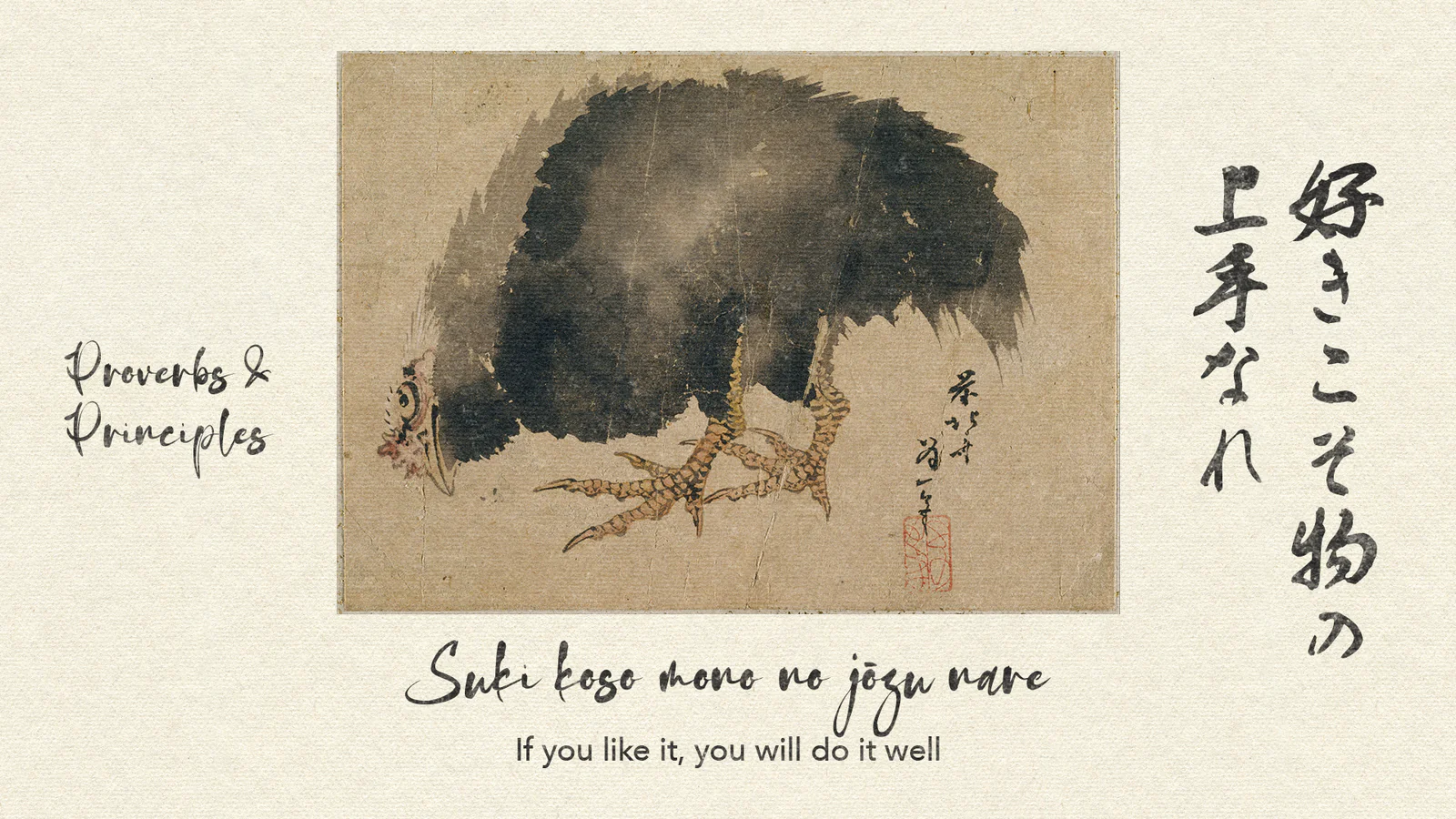
Katsushika Hokusai, Album of Sketches by Katsushika Hokusai and His Disciples (14.76.60) | Katsushika Hokusai, public domain, via Wikimedia Commons (The Met)
Suki koso mono no jōzu nare (好きこそ物の上手なれ): what you love, you do well. Whoever loves something practices more, with more pleasure, and ends up improving more.
Suki koso mono no jōzu nare (好きこそ物の上手なれ): o que se ama, faz-se bem. Quem gosta de uma coisa pratica mais, com mais prazer, e acaba melhorando mais.
Proverbs & Principles — 七転び八起き Nana korobi ya oki · Fall seven times, stand up eight
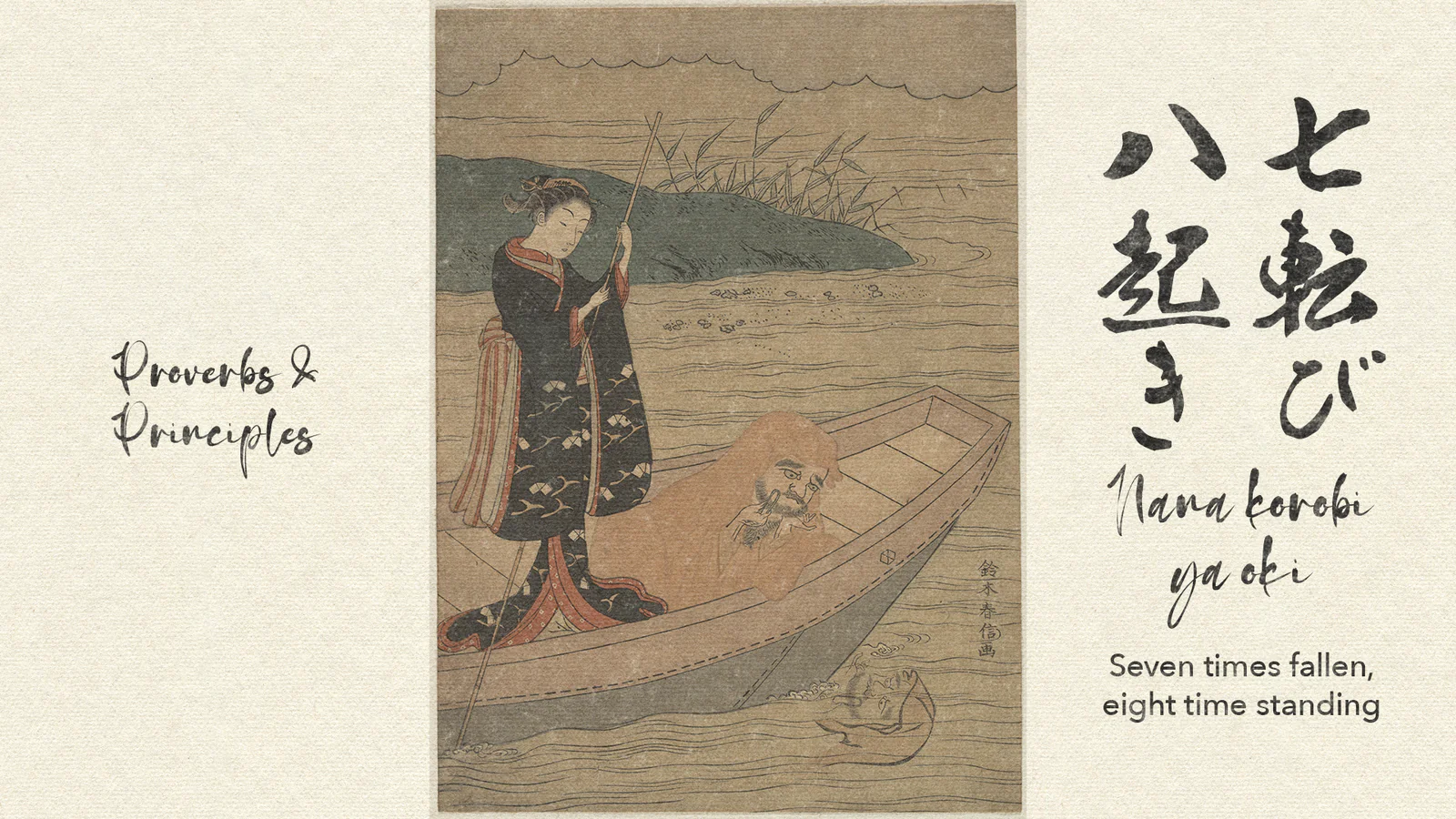
Daruma in a Boat with an Attendant | Suzuki Harunobu, public domain, via Wikimedia Commons
Nana korobi ya oki (七転び八起き): fall seven times, get up eight. It is about recovering from repeated setbacks without losing heart. One explanation ties the proverb to the daruma, the doll that rights itself when knocked over; the origin of the eight, however, is debated.
Nana korobi ya oki (七転び八起き): fall seven times, get up eight. It is about recovering from repeated setbacks without losing heart. One explanation ties the proverb to the daruma, the doll that rights itself when knocked over; the origin of the eight, however, is debated.
Proverbs & Principles — 一期一会 Ichi-go ichi-e · One Time, One Meeting
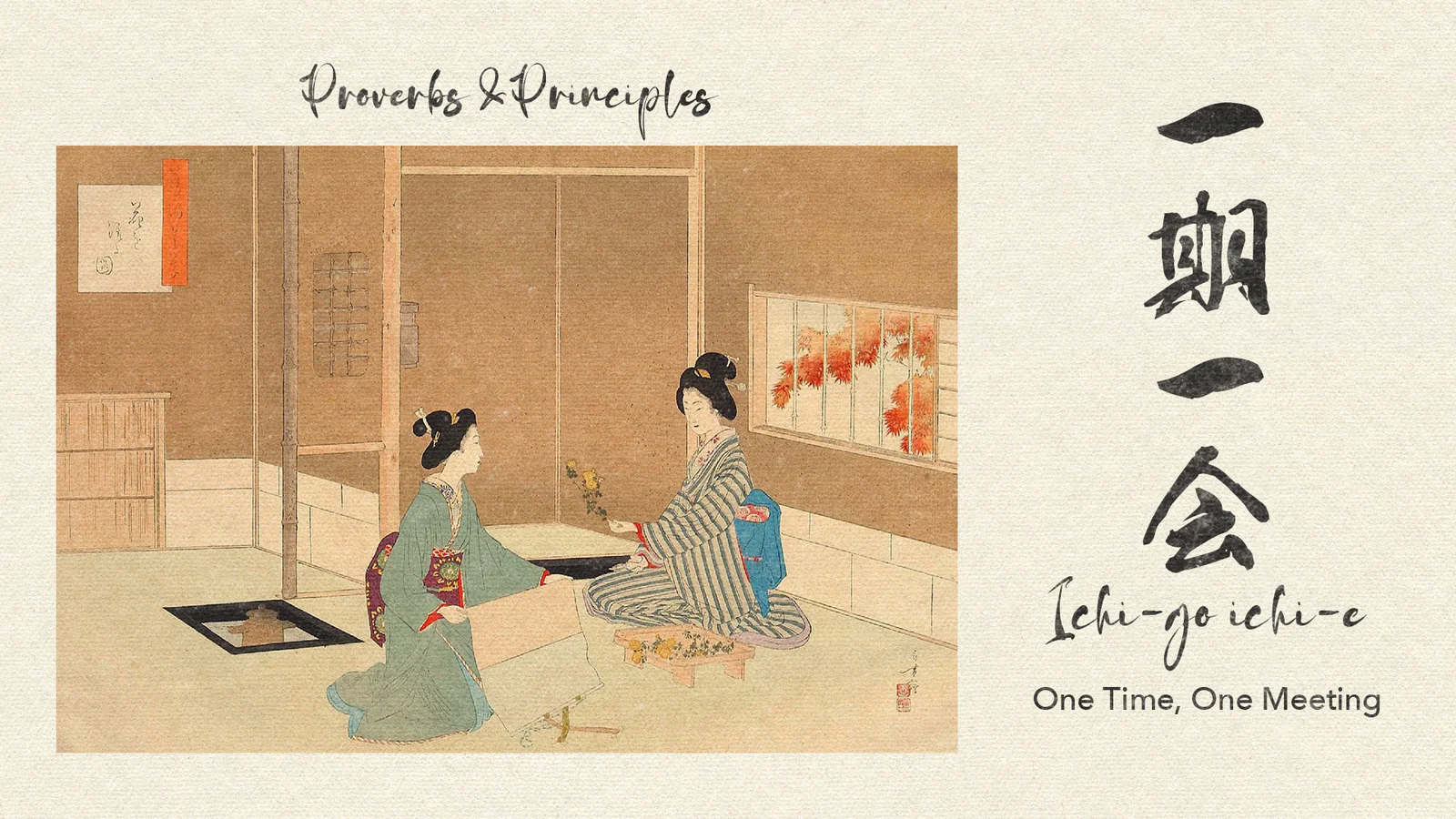
Cha no yu nichinichisō | Mizuno Toshikata, public domain, via Wikimedia Commons
Ichi-go ichi-e (一期一会): one time, one meeting. Each moment happens only once and does not return. The idea comes from the tea ceremony and is associated with the master Sen no Rikyū in the 16th century; 一期 (ichigo) is a Buddhist term for one lifetime. The lord Ii Naosuke developed it in the book Chanoyu Ichie Shū, around 1857.
Ichi-go ichi-e (一期一会): um momento, um encontro. Cada instante acontece uma única vez e não volta. A ideia vem da cerimônia do chá e é associada ao mestre Sen no Rikyū, no século XVI; 一期 (ichigo) é um termo budista para uma vida inteira. O senhor Ii Naosuke a desenvolveu no livro Chanoyu Ichie Shū, por volta de 1857.
Proverbs & Principles — 十人十色 Jūnin toiro · Ten people, Ten Colors
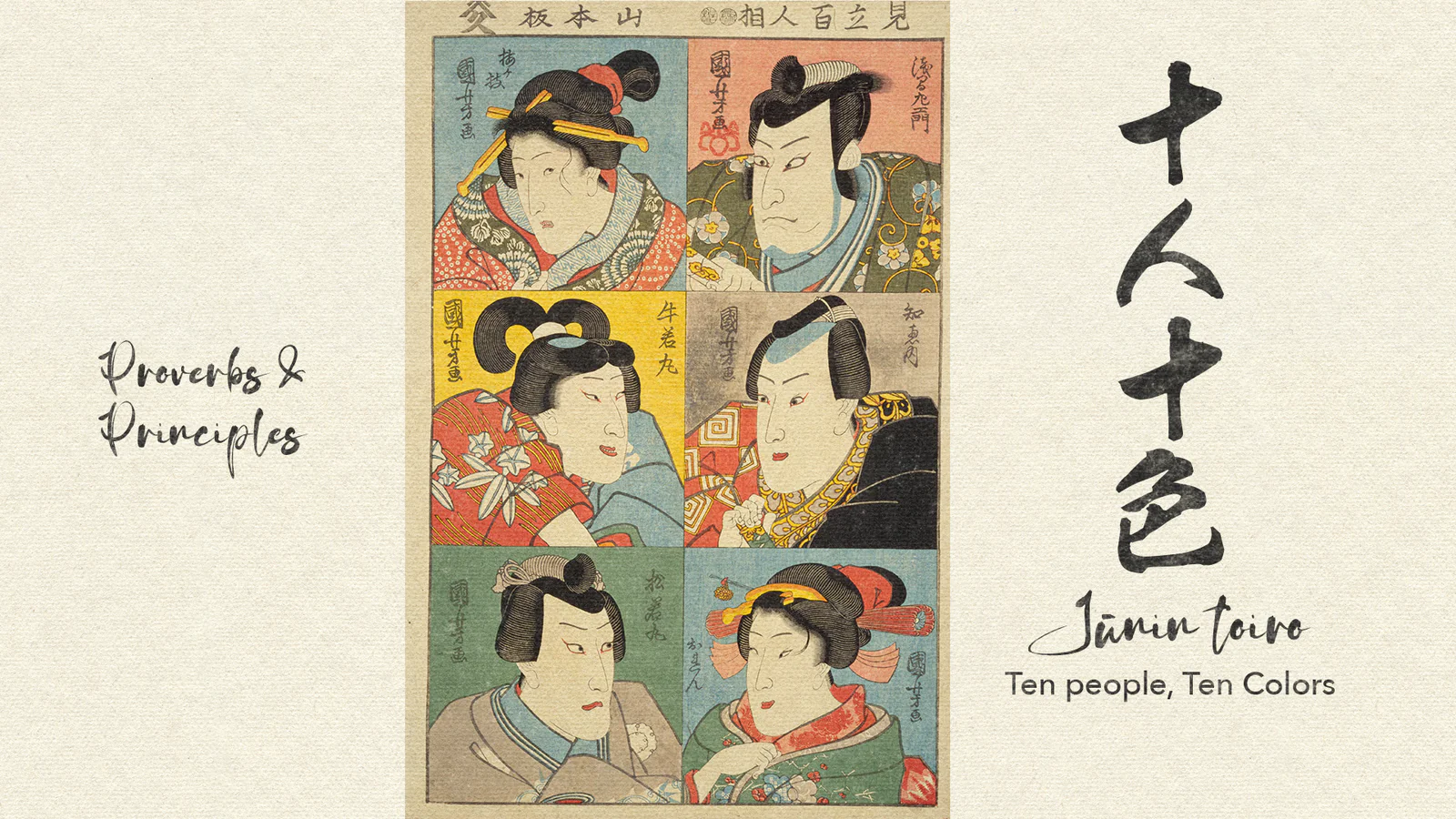
NDL-DC 1311289 | Utagawa Kuniyoshi, public domain, via Wikimedia Commons (National Diet Library)
Jūnin toiro (十人十色): ten people, ten colors. Each person thinks, feels and likes in their own way, and there is no reason to expect everyone to be alike. In English, the equivalent is to each their own.
Jūnin toiro (十人十色): dez pessoas, dez cores. Cada pessoa pensa, sente e gosta de um jeito próprio, e não há motivo para esperar que todo mundo seja igual. Em inglês, o equivalente é to each their own.
Proverbs & Principles — 知らぬが仏 Shiranu ga hotoke · ignorance is bliss
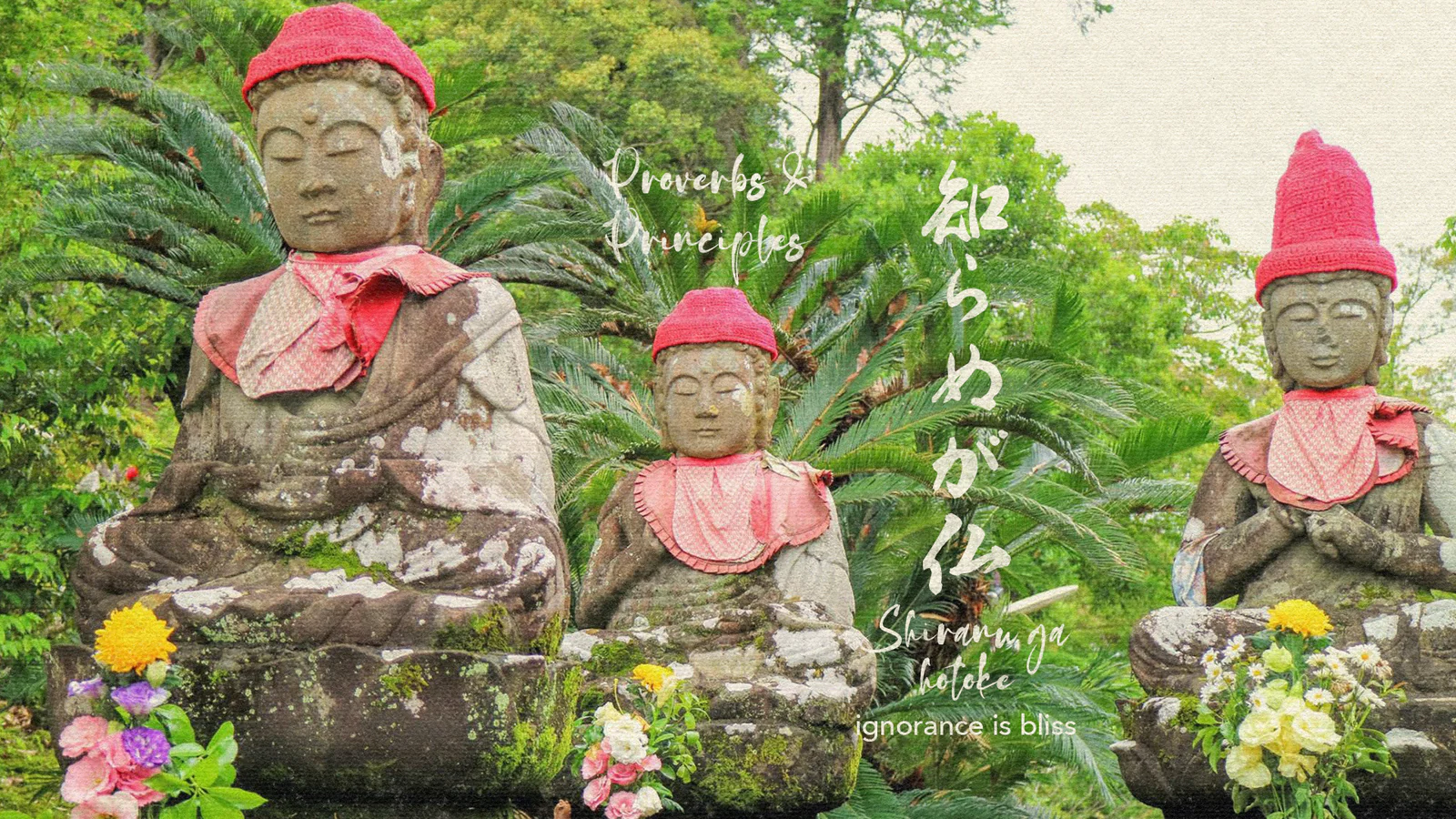
Stone Jizo statues with red caps and bibs, Kochi, June 2016 | Photo: NevinThompson, CC BY-SA 4.0, via Wikimedia Commons
Shiranu ga hotoke (知らぬが仏): not knowing is Buddha. Knowing the truth can bring anger and suffering; whoever does not know stays at peace, like a Buddha. Ignorance is bliss. It is sometimes said with a smile about someone who is calm only because they do not know what is going on. In English, the equivalent is ignorance is bliss.
Shiranu ga hotoke (知らぬが仏): não saber é ser um Buda. Saber a verdade pode trazer raiva e sofrimento; quem não sabe fica em paz, como um Buda. A ignorância é uma bênção. Às vezes se diz com um sorriso sobre quem está tranquilo só porque não sabe o que acontece. Em inglês, o equivalente é ignorance is bliss.
Proverbs & Principles — 猿も木から落ちる Saru mo ki kara ochiru · Even monkeys fall from trees
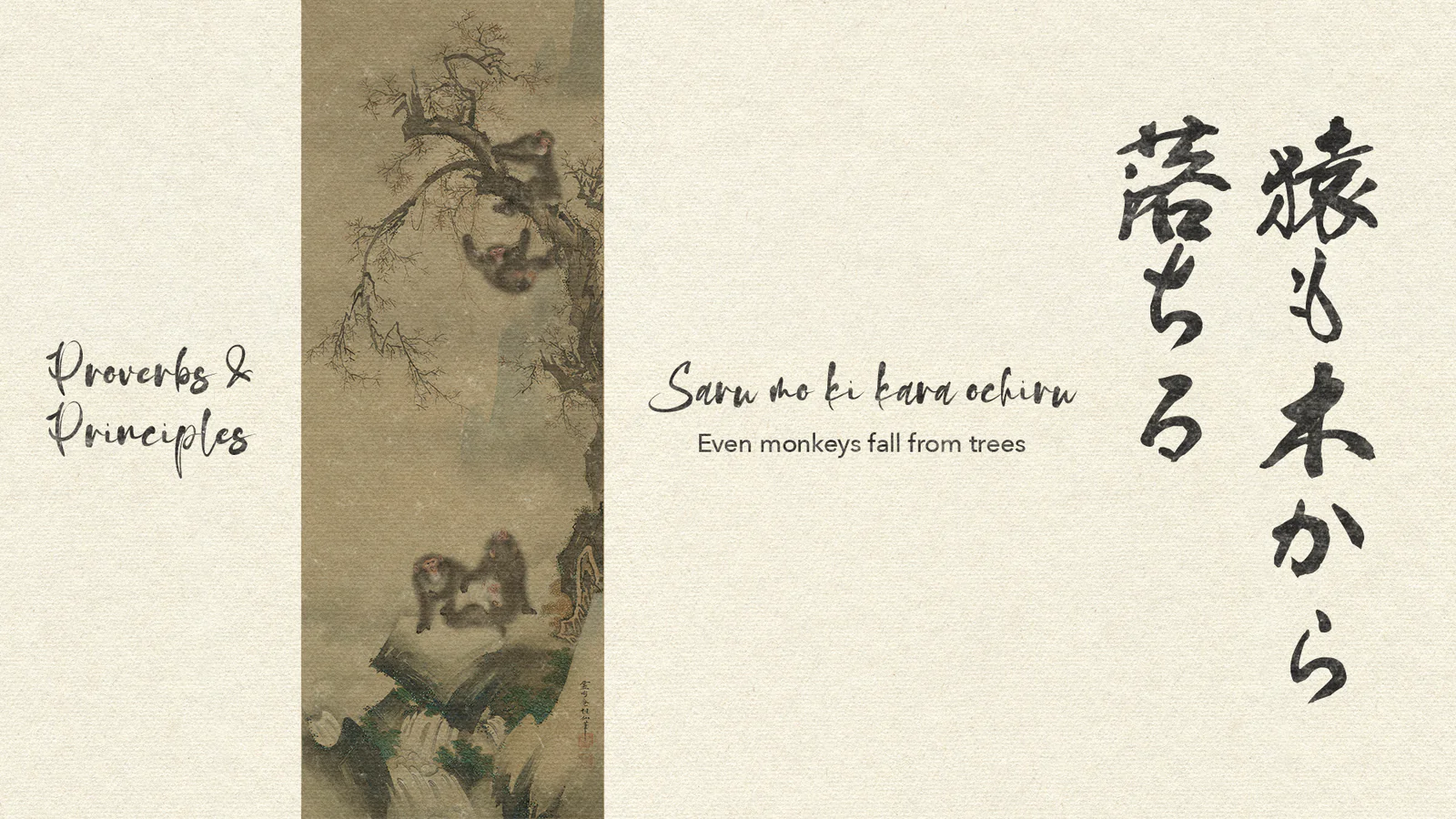
Mori Sosen, Monkey (1952.40.13) | Mori Sosen, public domain, via Wikimedia Commons (Yale University Art Gallery)
Saru mo ki kara ochiru (猿も木から落ちる): even monkeys fall from trees. Even the expert makes mistakes, and a mistake does not take away the value of someone who knows. The exact origin is unknown. There are relatives such as kappa no kawa nagare (even a kappa drowns).
Saru mo ki kara ochiru (猿も木から落ちる): até macacos caem das árvores. Mesmo o especialista erra, e errar não tira o valor de quem sabe. A origem exata não se conhece. Há provérbios parentes, como kappa no kawa nagare (até o kappa se afoga).
Proverbs & Principles — 言わぬが花 Iwanu ga hana · Not saying is the flower
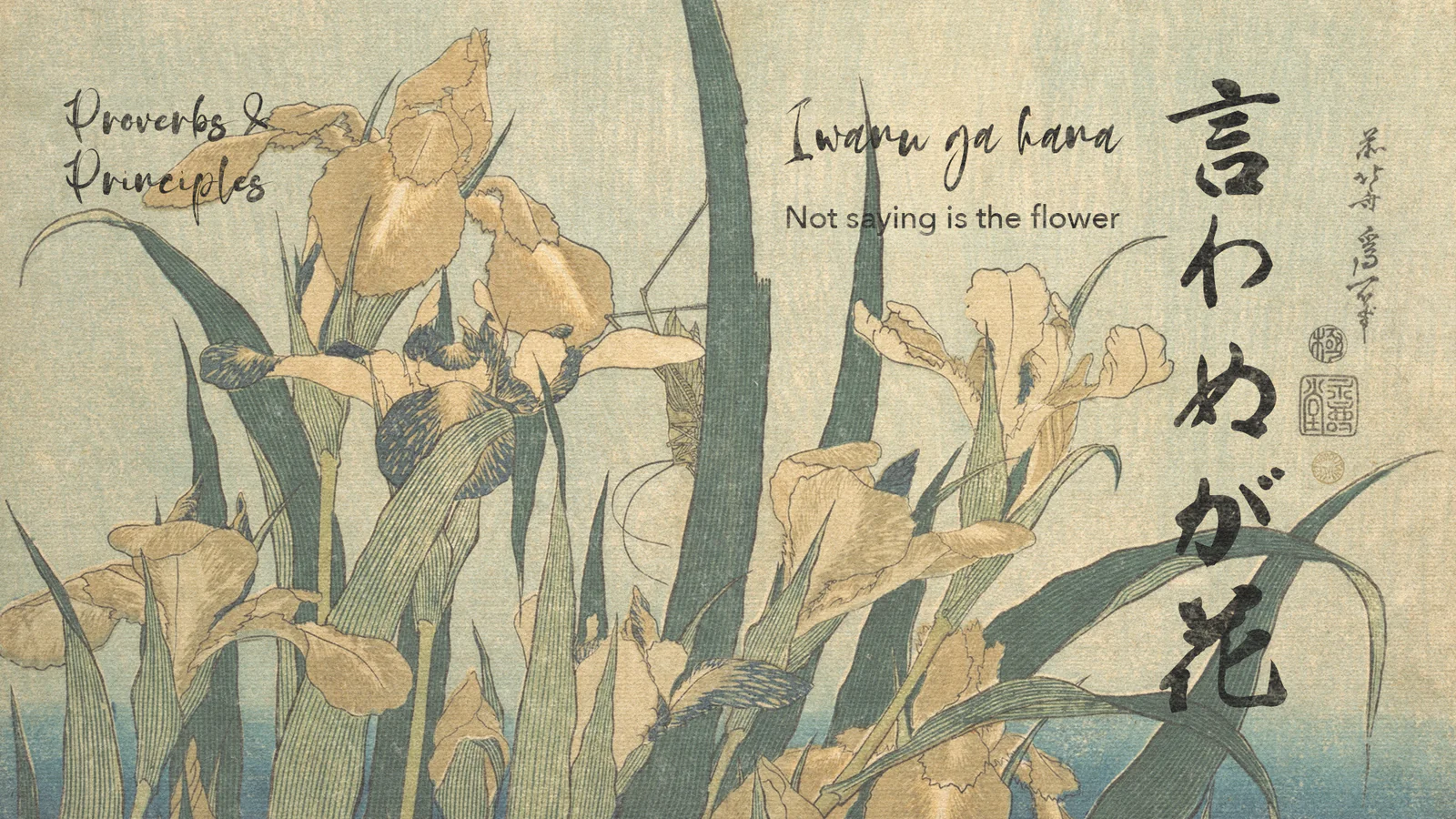
Irises and Grasshopper | Katsushika Hokusai, public domain, via Wikimedia Commons (The Met)
Iwanu ga hana (言わぬが花): not saying is the flower. Some things are more beautiful, and safer, left unsaid. The flower here stands for what has beauty and value. Saying everything removes room for imagination; silence lets the other person complete the meaning.
Iwanu ga hana (言わぬが花): não dizer é a flor. Certas coisas são mais belas e mais seguras quando não são ditas. A flor, aqui, é o símbolo do que tem beleza e valor. Dizer tudo tira o espaço da imaginação; o silêncio deixa o outro completar o sentido.
Proverbs & Principles — 岡目八目 Okame hachimoku · The onlooker sees eight moves ahead
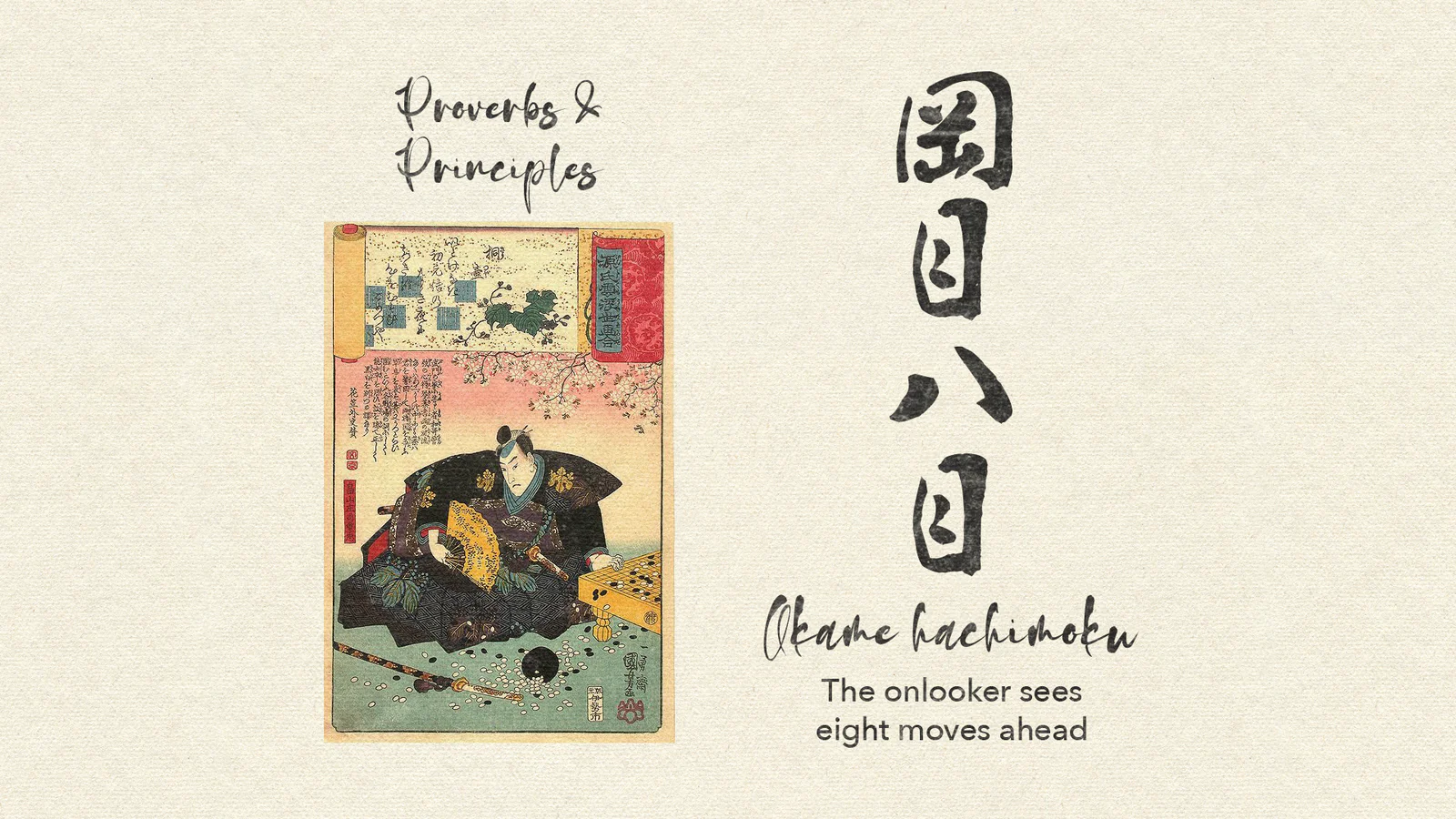
Go-Kuniyoshi | Utagawa Kuniyoshi, public domain, via Wikimedia Commons
Okame hachimoku (岡目八目): the onlooker sees eight moves ahead. It comes from the game of Go: whoever watches the game without being in it sees the position more coolly than the players. 岡目 and 傍目 are read the same, okame; the exact meaning of the number eight varies among explanations. Today it applies to any situation where an outsider sees better.
Okame hachimoku (岡目八目): quem olha de fora vê oito jogadas à frente. Vem do jogo de go: quem assiste à partida, sem estar nela, enxerga a situação com mais frieza do que os jogadores. 岡目 e 傍目 se leem igual, okame; o sentido exato do número oito varia entre as explicações. Hoje vale para qualquer situação em que quem está de fora vê melhor.
Proverbs & Principles — 花鳥風月 Kachō fūgetsu · Flower, bird, wind, moon
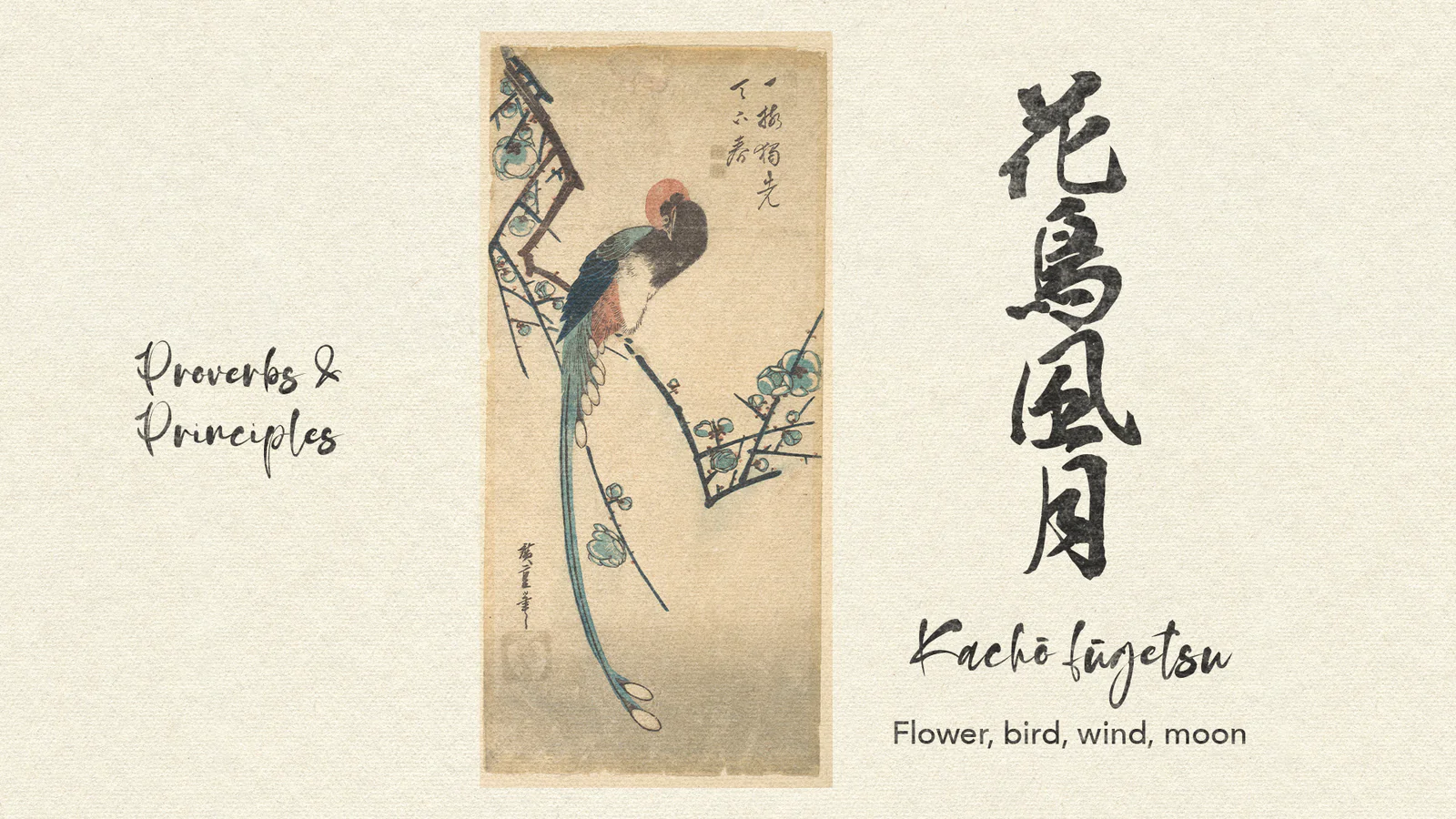
Long Tailed Bird, MET DP121506 | Utagawa Hiroshige, CC0, via Wikimedia Commons (The Met)
Kachō fūgetsu (花鳥風月): flower, bird, wind, moon. It sums up the beauty of nature and the arts made from it, from poetry to painting. One of the earliest records is the Fūshikaden, Zeami’s treatise on Noh theater (15th century), where the phrase still meant refined elegance. Only later did it take today’s sense.
Kachō fūgetsu (花鳥風月): flor, pássaro, vento, lua. Resume a beleza da natureza e as artes feitas a partir dela, da poesia à pintura. Um dos registros mais antigos é o Fūshikaden, tratado de Zeami sobre o teatro nô (século XV), em que a expressão ainda queria dizer elegância refinada. Só depois passou ao sentido de hoje.
The Five Rings · 五輪書
The Five Rings — 地 Chi · Ground
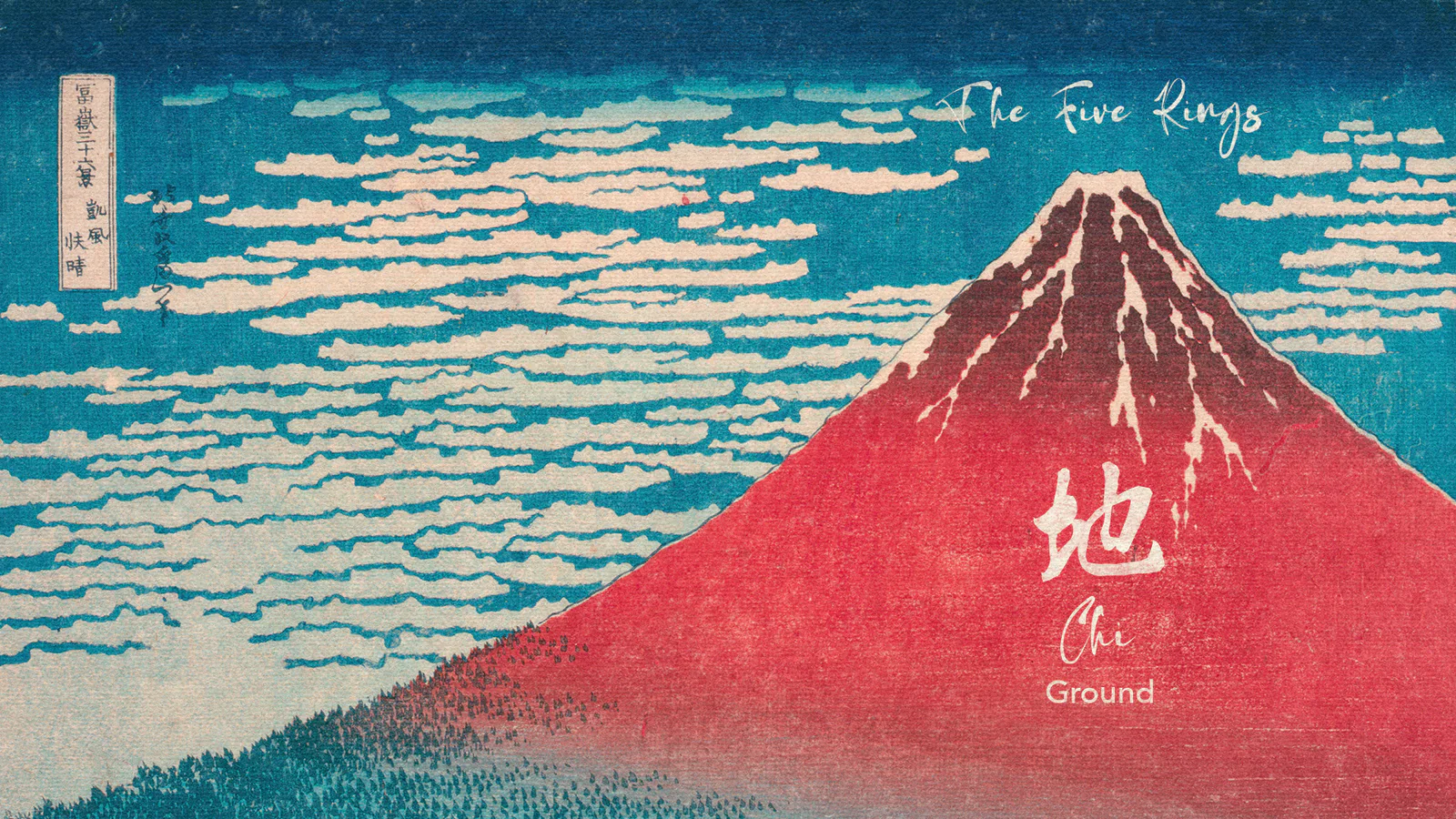
Katsushika Hokusai, Fine Wind, Clear Morning (Gaifū kaisei) | Katsushika Hokusai, public domain, via Wikimedia Commons (Google Art Project)
Chi (地), Ground, is the first scroll of Miyamoto Musashi’s Book of Five Rings, written between 1643 and 1645. It is the introduction, and uses the image of building a house to talk about training and leadership. The scroll gathers nine rules for learning, among them training the eye to see every detail and doing nothing useless.
Chi (地), Terra, é o primeiro rolo do Livro dos Cinco Anéis, de Miyamoto Musashi, escrito entre 1643 e 1645. É a introdução, e usa a imagem de construir uma casa para falar de treino e de liderança. O rolo reúne nove regras de aprendizado, entre elas treinar o olhar para ver cada detalhe e não fazer nada inútil.
The Five Rings — 水 Sui · Water
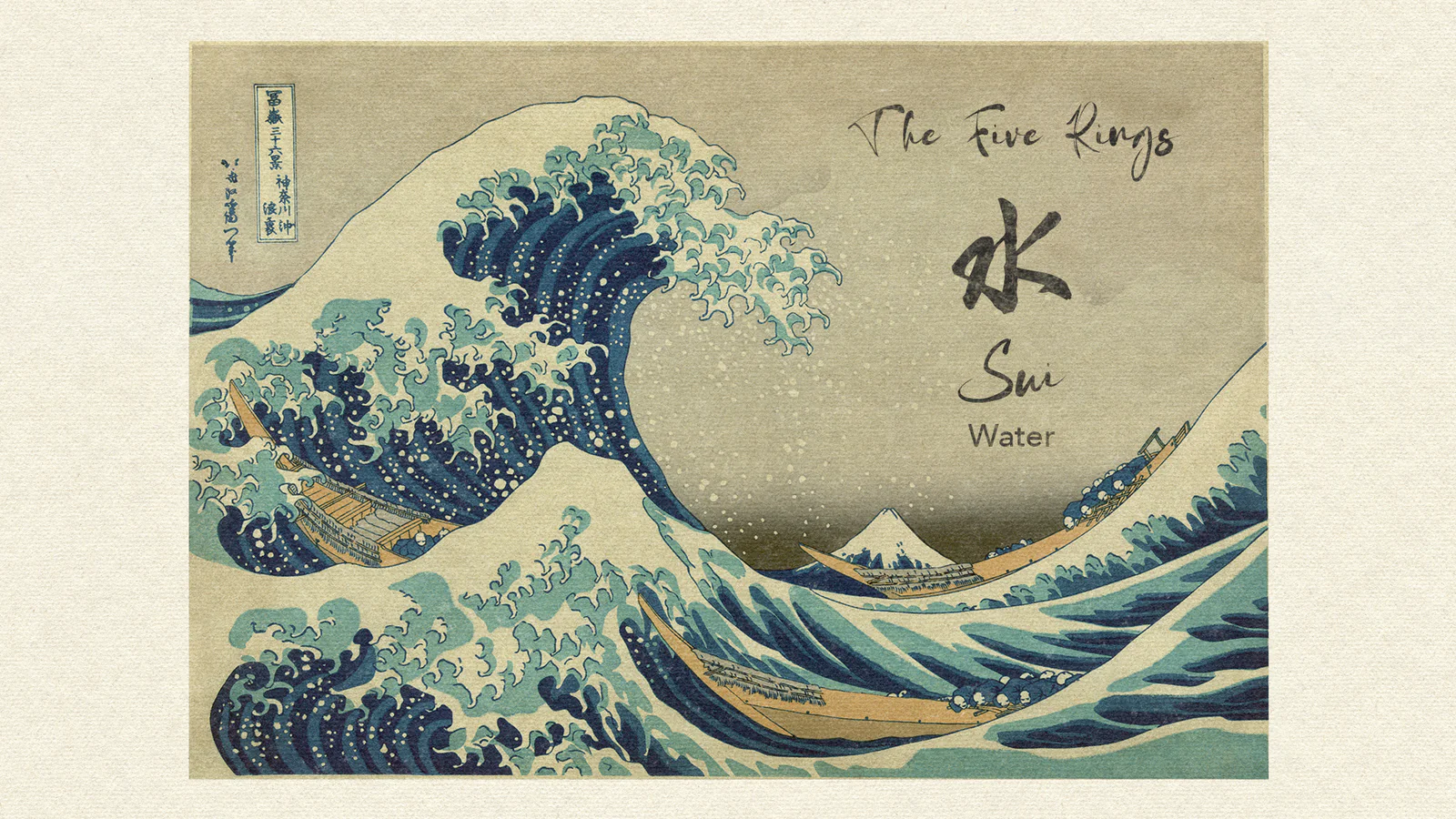
Great Wave off Kanagawa2 | After Katsushika Hokusai, public domain, via Wikimedia Commons
Sui (水), Water, is the scroll of basic technique and of Musashi’s own style, Niten Ichi-ryū (Two Heavens, One Style). Water is the image of flexibility: a mind that takes the shape of its vessel. Master the basics, then adapt to the subject and the place.
Sui (水), Água, é o rolo da técnica básica e do estilo de Musashi, o Niten Ichi-ryū (Dois Céus, Uma Escola). A água é a imagem da flexibilidade: a mente que toma a forma do recipiente. Domine o básico e depois se adapte ao assunto e ao lugar.
The Five Rings — 火 Ka · Fire
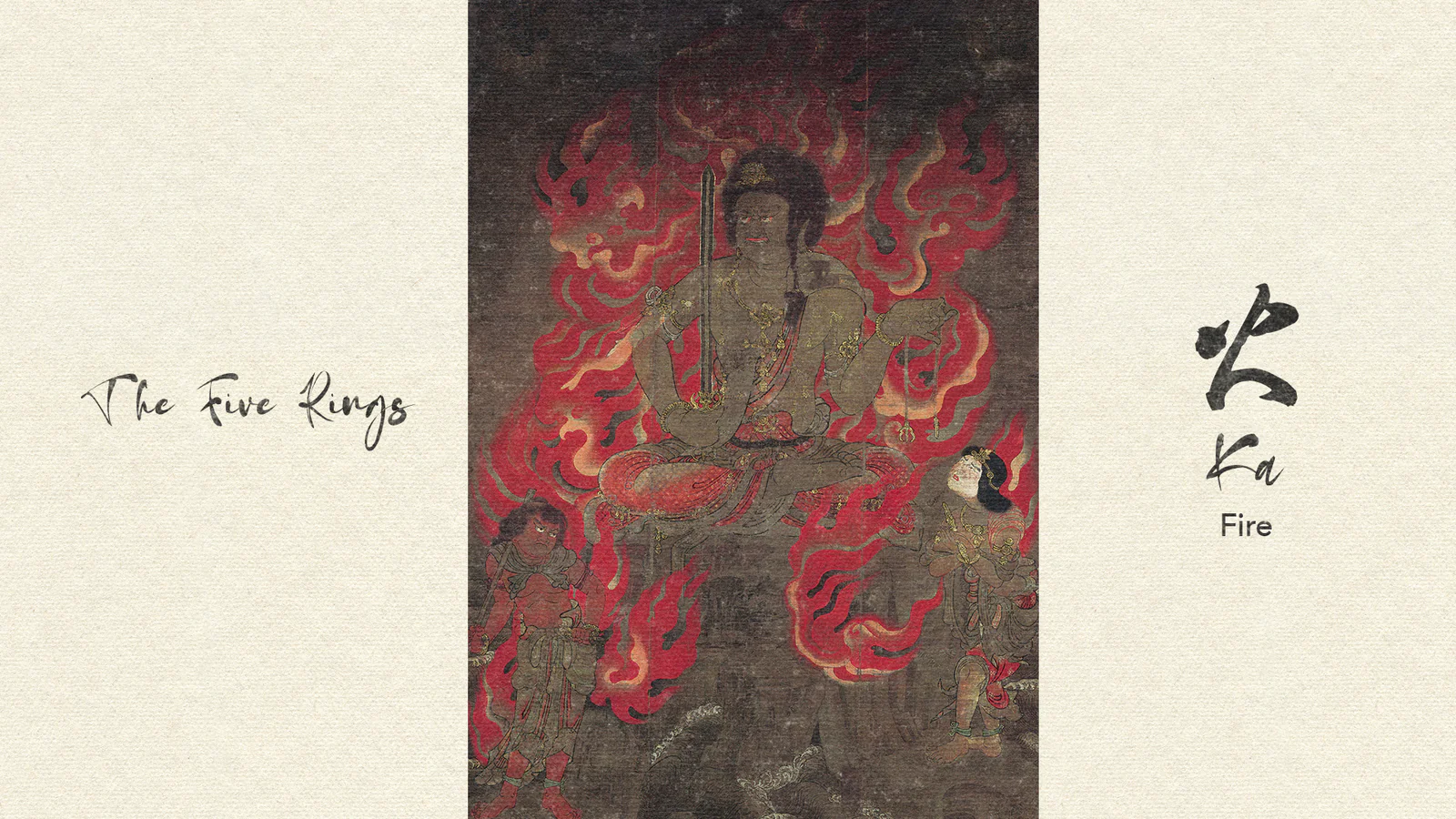
Fudō Myōō | Unknown author, public domain, via Wikimedia Commons
Ka (火), Fire, is the scroll of the heat of battle: strategy, perspective and the different kinds of timing. It speaks of using position, being unpredictable, and balancing small detail with big vision, the image of the rat’s head and the ox’s neck.
Ka (火), Fogo, é o rolo do calor da batalha: estratégia, perspectiva e os diferentes tipos de tempo, ou timing. Fala de usar a posição, de ser imprevisível e de equilibrar o detalhe pequeno com a visão grande, a imagem da cabeça de rato e do pescoço de boi.
The Five Rings — 風 Fū · Wind
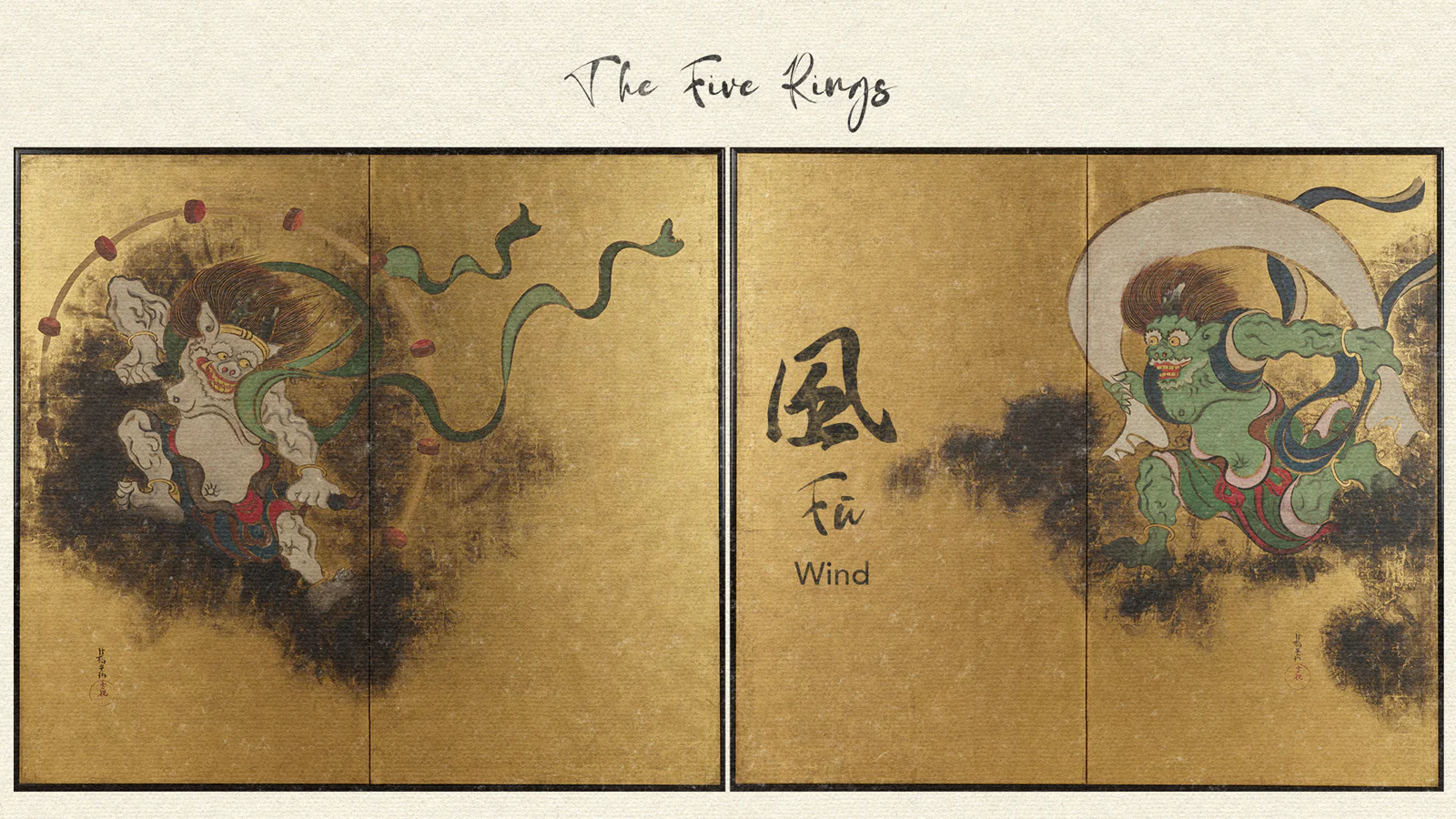
Wind God and Thunder God Screens | Ogata Kōrin, public domain, via Wikimedia Commons
Fū (風), Wind, is the scroll that examines the sword schools of the day and what Musashi saw as their failings. The title is a pun: the kanji 風 means wind and also style, as in a style of fighting. The lesson: do not get stuck on a school or on the tool, the sword or the camera, or on the lure of new gear.
Fū (風), Vento, é o rolo que examina as escolas de esgrima da época e o que Musashi via como suas falhas. O título é um jogo de palavras: o kanji 風 quer dizer vento e também estilo, como em estilo de combate. A lição: não se prender a uma escola nem à ferramenta, a espada ou a câmera, nem ao fascínio por equipamento novo.
The Five Rings — 空 Kū · Void
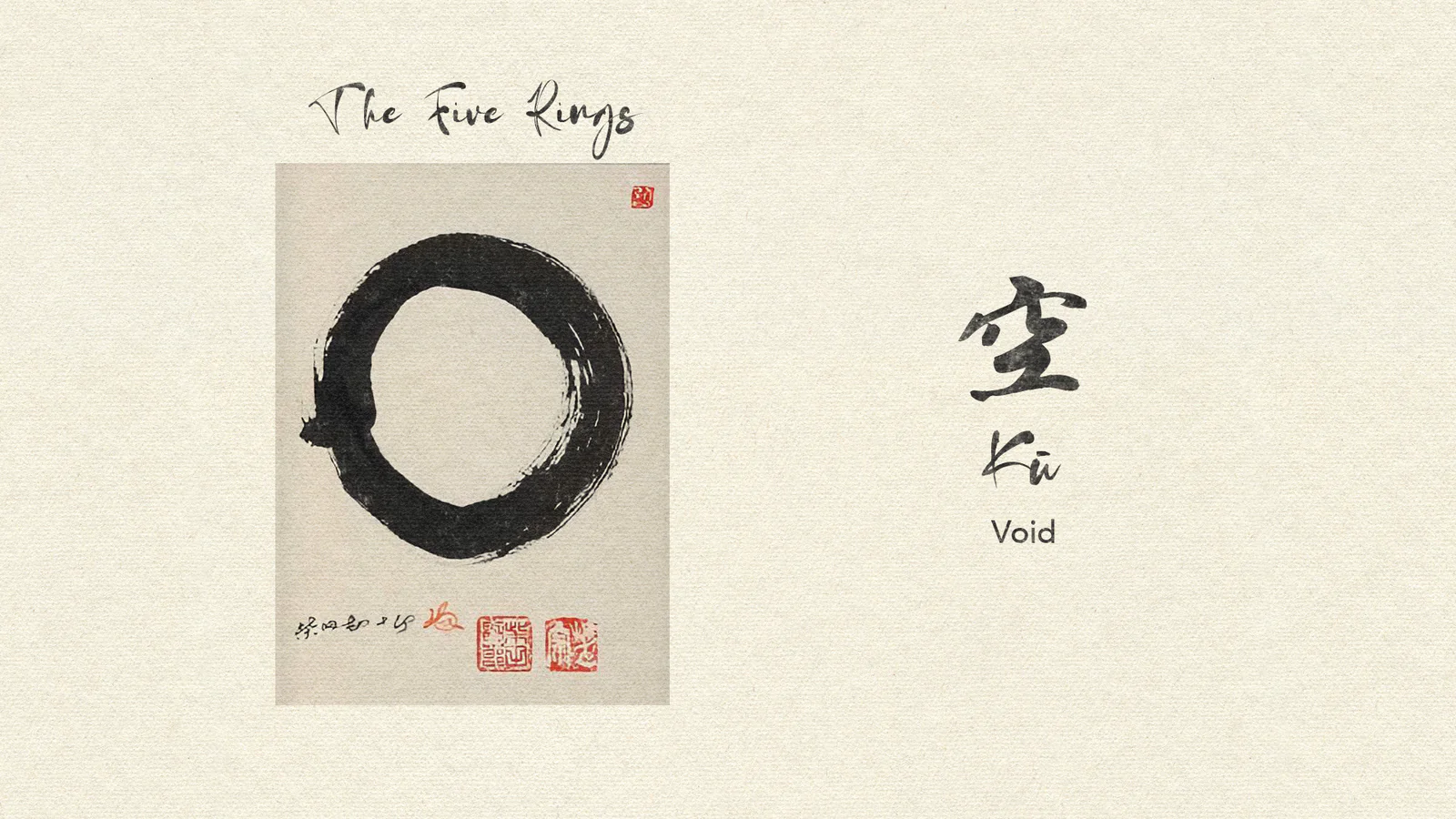
Enso | Kanjuro Shibata XX, Ensō (円相), CC BY-SA 3.0, via Wikimedia Commons
Kū (空), Void, is a short epilogue, probably Zen-inspired, on consciousness and the right mindset. The lesson is to act without forcing, to stay suspicious of your own quality, and to keep the mind empty. It is the same Kū as emptiness as possibility.
Kū (空), Vazio, é um epílogo curto, provavelmente de inspiração zen, sobre a consciência e a mentalidade certa. A lição é agir sem forçar, desconfiar da própria qualidade e manter a mente vazia. É o mesmo Kū do vazio como possibilidade.
Sources · Fontes
- 8 Japanese Aesthetics That Might Change How You See Beauty, dans le gris: os oito traços, segundo Masayuki Kurokawa
- 7 Japanese Zen Aesthetic Principles, dans le gris e 5 Hidden Principles, dans le gris: sete princípios do wabi-sabi, yohaku no bi, shakkei, iki, shitsurai e yoin
- How Japanese Everyday Objects Reflect Beauty and Craftsmanship, dans le gris: yō no bi, monozukuri e mottainai
- Japanese Aesthetics, Stanford Encyclopedia of Philosophy: wabi, sabi, yūgen, mono no aware, iki
- Japanese aesthetics, Wikipedia: os sete princípios e Hisamatsu Shin’ichi
- Mono no aware e Suntory Museum of Art: Motoori Norinaga e o sentido amplo de aware
- Kintsugi: origem incerta, urushi, Ashikaga Yoshimasa
- Ichi-go ichi-e e Hikone Castle Museum: Rikyū e Ii Naosuke
- Shuhari: as três etapas shu, ha, ri
- Ma (negative space), Borrowed scenery e Entsū-ji
- Maki-e, Shibui, Mottainai e Monozukuri
- The Book of Five Rings: os cinco rolos
- Shūzō Kuki: A Estrutura do Iki
- Resenha de 2007 do livro de Kurokawa na revista Design Theory 50 (Universidade de Osaka): https://ir.library.osaka-u.ac.jp/repo/ouka/all/52822/jjsd50_192.pdf
- Provérbios: dicionários e páginas em japonês e inglês (Digital Daijisen, USC Folklore, Takase, Tokyo Weekender); a origem exata de vários deles não é documentada.